 Find this author on Google Scholar
 Find this author on PubMed
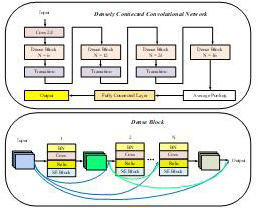
Facial expression recognition (FER) under unconstrained environments faces two severe challenges: class imbalance and the loss of high-frequency texture information. To address these challenges, this study proposes TexGeo-Net, a dual-stream deep architecture that effectively rebalances the training data distribution to mitigate the long-tail effect by employing a landmark-guided geometric augmentation strategy while simultaneously utilizing local binary patterns to precisely preserve micro-texture details. In terms of model design, the system adopts the Densely Connected Convolutional Network as the backbone and deeply integrates the Squeeze-and-Excitation channel attention mechanism. Through adaptive feature fusion, this design compensates for the spatial information loss caused by downsampling in deep networks. Experimental results on three benchmark datasets—CK+, RAF-DB, and FER2013—demonstrate that TexGeo-Net performs competitively with existing methods in terms of recognition accuracy and robustness across these heterogeneous datasets. This validates the complementary advantages of geometric structures and texture features, demonstrating the feasibility of TexGeo-Net in real-world applications.
Zi-Jie Lin, Ching-Yi Chen, "Deep Neural Networks with Local Texture and Geometric Augmentation for Facial Expression Recognition" in Journal of Imaging Science and Technology, 2026, pp 1 - 10, https://doi.org/10.2352/J.ImagingSci.Technol.2026.70.5.050403