 Find this author on Google Scholar
 Find this author on PubMed
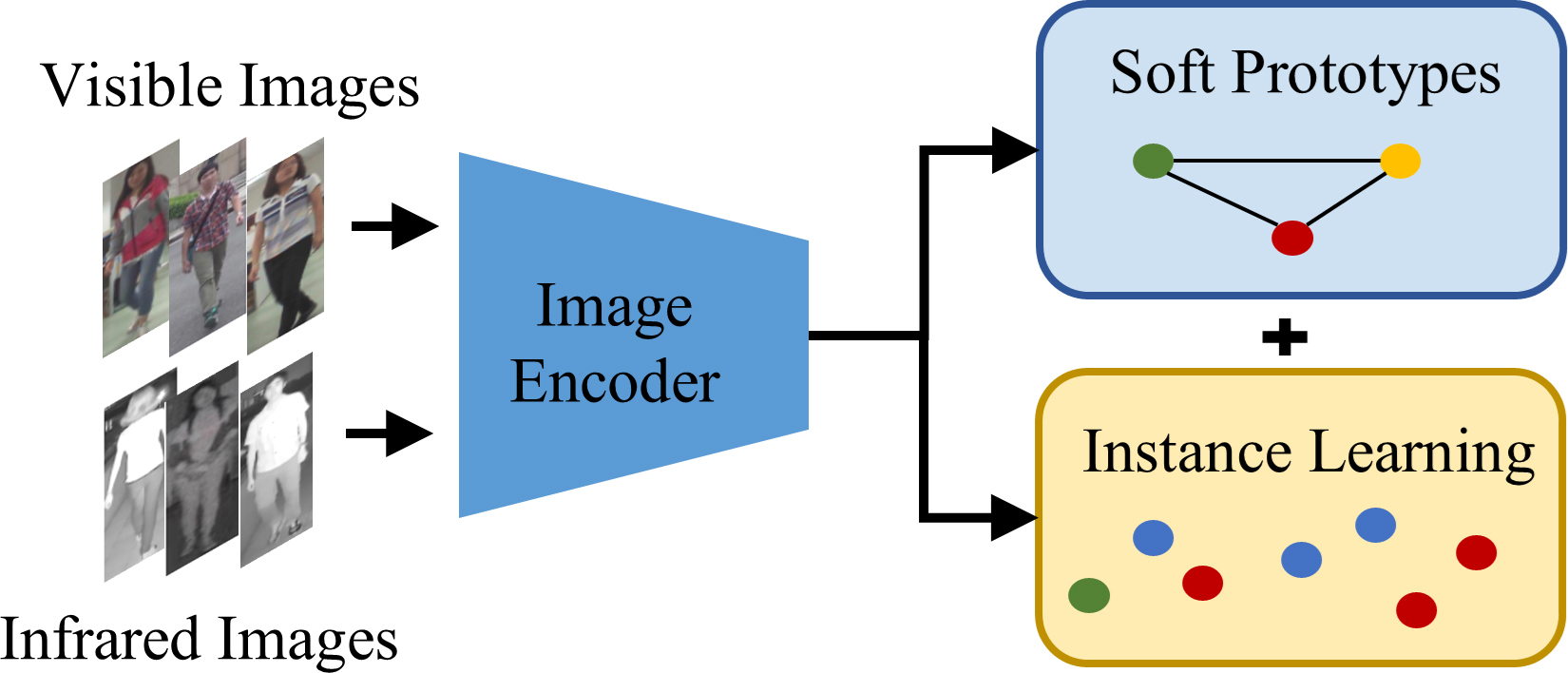
Unsupervised visible–infrared person re-identification (USVI-ReID) is a very important and challenging task in machine vision. The key challenge of USVI-ReID is to effectively mine weak class-wise supervision and establish cross-modal correspondences without using any manual annotations. In this paper, the authors propose a soft prototype contrastive learning and instance discrimination method for USVI-ReID. Specifically, soft prototype contrastive learning selects the nearest neighbors with high similarity to the soft prototypes to mine accurate information and guide the model to learn more discriminative features. On this basis, a soft weighting strategy is used to quantitatively measure the relevance of the selected soft prototypes relative to the current centroid prototype, thus further eliminating the interference of the wrong prototype in the model training. To overcome the problems of image noise and complex backgrounds in visible and infrared images, instance discriminative learning is first integrated into USVI-ReID to explore the potential similarity relationship between instances from the bottom up and learn discriminative representations. Finally, the authors propose a progressive training strategy, which enables the model to learn the similarities between instances in the early stage of training and gradually shift its attention to more discriminative categories in the later stage. Extensive experiments are conducted on two public datasets, and quantitative results prove the effectiveness of the proposed method.
Mengke Li, Jianwei Yang, "Soft Prototype Contrastive Learning and Instance Discrimination for Unsupervised Visible–Infrared Person Re-Identification" in Journal of Imaging Science and Technology, 2026, pp 1 - 10, https://doi.org/10.2352/J.ImagingSci.Technol.2026.70.4.040505