 Find this author on Google Scholar
 Find this author on PubMed
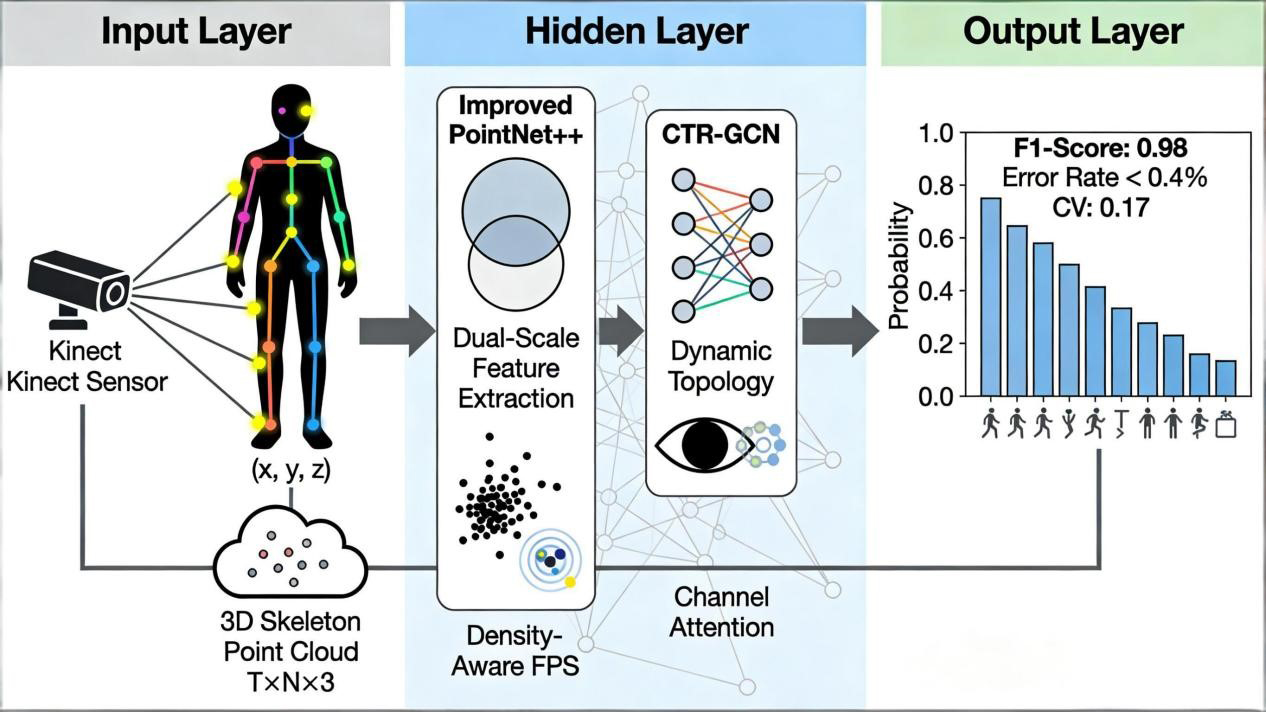
This study proposes a human dynamic behavior recognition method based on joint point extraction and deep learning algorithms. Human skeletal information is collected using a Kinect camera to obtain three-dimensional (3D) joint coordinates, completing the extraction of skeletal joint data. Based on the characteristics of bones in 3D space, processing is performed using 3D skeletal joint point cloud data. An improved PointNet++ method is employed to process the point cloud data: a dual-scale feature extraction strategy is adopted to enhance the network’s multiscale feature capture capability, and the farthest point sampling algorithm is optimized to better preserve behavioral details. Finally, a graph convolutional network approach incorporating a channel attention mechanism and graph topology optimization is used to achieve human dynamic behavior recognition based on 3D skeletons. Experimental results show that the method achieves a maximum
Lei Ma, Yunwei Li, "Human Dynamic Behavior Recognition Method based on Joint Point Extraction and Deep Learning Algorithm" in Journal of Imaging Science and Technology, 2026, pp 1 - 14, https://doi.org/10.2352/J.ImagingSci.Technol.2026.70.4.040504