 Find this author on Google Scholar
 Find this author on PubMed
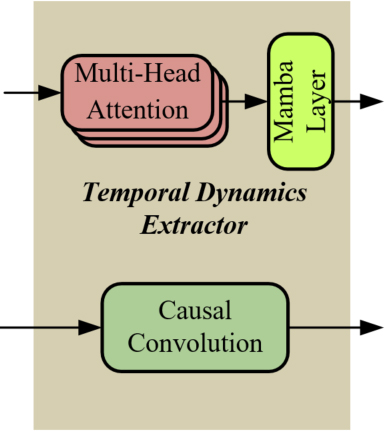
Traffic flow forecasting faces substantial challenges arising from intertwined heterogeneous temporal dynamics and complex spatial dependencies. A key difficulty lies in balancing long-term stable trends with short-term abrupt disturbances. To address these challenges, a framework named the Spatiotemporal Trend–Event Decoupling Mamba Graph Network (STEDMGN) is proposed. First, a temporal signal separation layer is constructed using a multi-scale decomposition and reconstruction mechanism to divide the raw sequence into trend and event components. This design enables dynamic pattern decoupling across multiple scales. Subsequently, a dual-frequency spatiotemporal encoder is introduced. The trend branch integrates multi-head attention with a Mamba-based state space layer to capture cross-period long-term dependencies, whereas the event branch employs causal convolution to model short-term abrupt disturbances. In the spatial dimension, trend-oriented and event-oriented graph convolutional networks are incorporated. These networks combine static priors, adaptive adjacency, and feature-driven dynamic graph structures to enhance the representation of both stable topologies and time-varying propagation. Finally, a fusion-gated decoder employs gated units and a query-driven fusion strategy to integrate the two feature types. A subsequent regression layer then generates multi-step forecasts. Extensive experiments on four public PeMS datasets demonstrate that the STEDMGN substantially outperforms state-of-the-art methods. The results provide an accurate and scalable solution for large-scale urban traffic flow forecasting.
Rui An, Jianxin Cao, Tengfei Zhao, "Spatiotemporal Trend–Event Decoupling Mamba Graph Network for Traffic Flow Forecasting" in Journal of Imaging Science and Technology, 2026, pp 1 - 15, https://doi.org/10.2352/J.ImagingSci.Technol.2026.70.4.040502