 Find this author on Google Scholar
 Find this author on PubMed
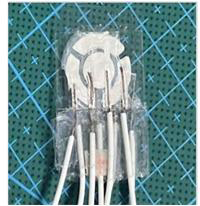
This paper designs a wearable pulse sensor based on the flexible poly(vinylidene fluoride–trifluoroethylene) (P(VDF–TrFE)) piezoelectric film to address issues such as discomfort, inconvenience, and low accuracy in traditional pulse sensors. The sensor aims to achieve continuous detection of human pulse signals, providing robust support for the prevention and treatment of cardiovascular diseases. First, flexible P(VDF–TrFE) piezoelectric films were prepared as the sensor substrate by using the tape-casting method. Conductive electrodes were printed on the film’s surface via screen-printing technology, and square- and circular-array sensors were developed by incorporating a mesh shielding layer design for comparative performance evaluation in pulse signal acquisition. Second, to address the low-frequency and weak nature of pulse signals, which are prone to various noise interferences, a precise signal conditioning circuit with amplification and filtering functionalities was designed to acquire high-fidelity and low-noise pulse wave signals. Experimental results demonstrate that the prepared P(VDF–TrFE) film exhibits excellent dielectric, piezoelectric, and ferroelectric properties with a maximum
Pu Xuan Ma, Xu Sheng Wang, Tao Han, TianQi Liu, Ke Ran Ren, CongJun Cao, "Design of a Wearable Pulse Sensor based on Flexible Piezoelectric Film" in Journal of Imaging Science and Technology, 2026, pp 1 - 18, https://doi.org/10.2352/J.ImagingSci.Technol.2026.70.3.030415