 Find this author on Google Scholar
 Find this author on PubMed


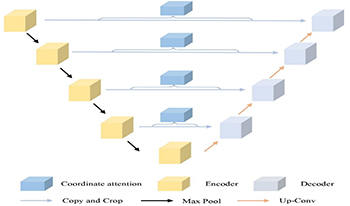
The maintenance of critical transportation infrastructure such as roads, tunnels, and bridges depends heavily on timely and accurate detection of structural damage. Among various types of surface defects, concrete cracks are the most common and dangerous. However, traditional manual inspection methods are inefficient, labor-intensive, and pose safety risks. In this paper, the authors propose UC-Net, a novel semantic segmentation network specifically designed for concrete crack detection. The UC-Net builds upon the U-Net architecture and introduces a Coordinate Attention mechanism into skip connections, enabling the model to better capture long, narrow, and spatially scattered crack features while suppressing irrelevant background noise. This design addresses two key challenges: the small spatial proportion of cracks in high-resolution images and the interference from complex textures and lighting conditions. To validate the effectiveness of this approach, the authors conducted extensive experiments on a publicly available crack dataset and real-world images. Compared with existing CNN- and attention-based networks, UC-Net achieves superior performance, with improvements in IOU (up to 91.78%) and accuracy (89.33%). The results confirm that UC-Net provides a lightweight yet accurate solution for fine-grained crack segmentation, and it can serve as a practical tool in real-world infrastructure monitoring scenarios.
Yuhao Zhang, Beibei Li, "Concrete Crack Image Segmentation based on UC-Net" in Journal of Imaging Science and Technology, 2026, pp 1 - 8, https://doi.org/10.2352/J.ImagingSci.Technol.2026.70.2.020501