 Find this author on Google Scholar
 Find this author on PubMed


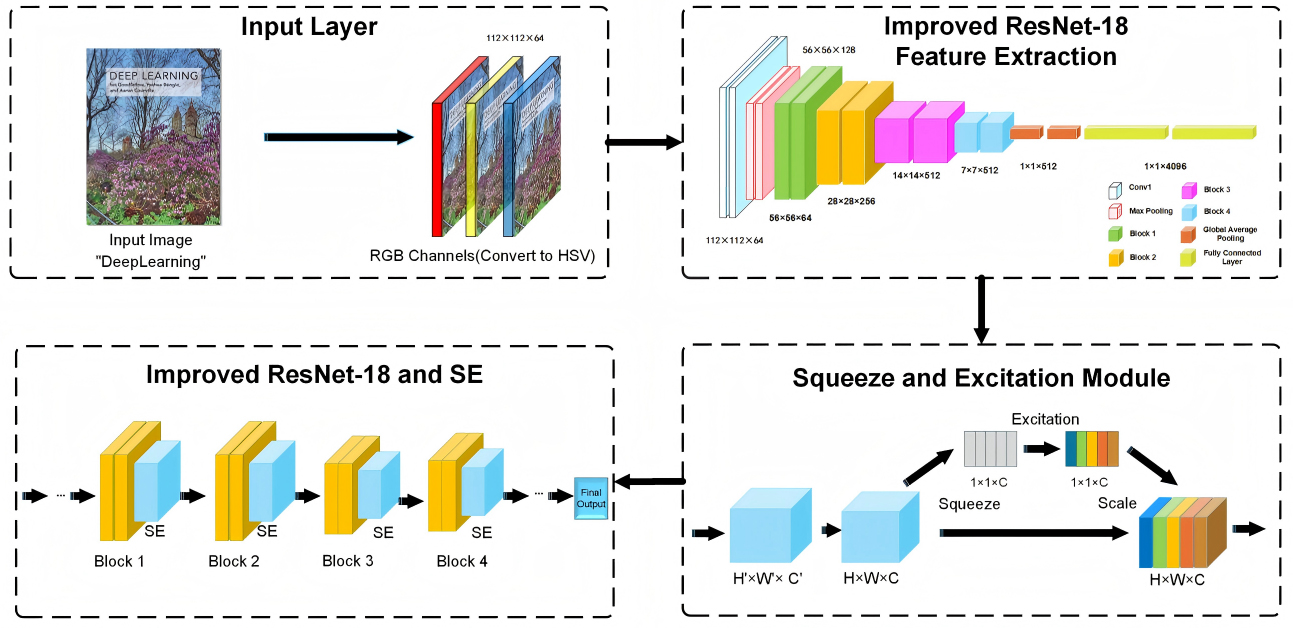
This paper proposes a deep-learning-based method for detecting color defects in book covers, achieved by integrating an improved Residual Network-18 (ResNet-18) architecture with the squeeze-and-excitation (SE) module for feature optimization. Addressing the color quality monitoring needs in industrial scenarios, a three-stage optimization strategy is adopted: at the data level, diversified samples are generated by combining the Hue, Saturation, and Value color space perturbation with mixed data augmentation techniques, and the synthetic minority oversampling technique is applied to solve class imbalance; at the model level, the ResNet-18 fully connected layers are reconstructed, and the SE channel attention mechanism is embedded to enhance feature representation; at the training level, a binary cross-entropy loss function is designed alongside dynamic learning rate scheduling, and K-fold cross-validation is utilized to ensure model stability. Experimental results show that the proposed method achieves a detection accuracy of 99.82% on the test set (RMSE = 0.1490), with an image processing time of only 57.66 ms per image. Its classification performance, robustness, and computational efficiency significantly outperform traditional pixel analysis methods, support vector machines, and backpropagation neural networks, providing an efficient solution for intelligent printing quality detection.
Tian Mingyu, Li Hongfeng, Gao Zhenqing, "Research on Book Cover Color Defect Detection Based on Improved ResNet-18 and Squeeze-and-Excitation Fusion" in Journal of Imaging Science and Technology, 2026, pp 1 - 10, https://doi.org/10.2352/J.ImagingSci.Technol.2026.70.1.010410