 Find this author on Google Scholar
 Find this author on PubMed


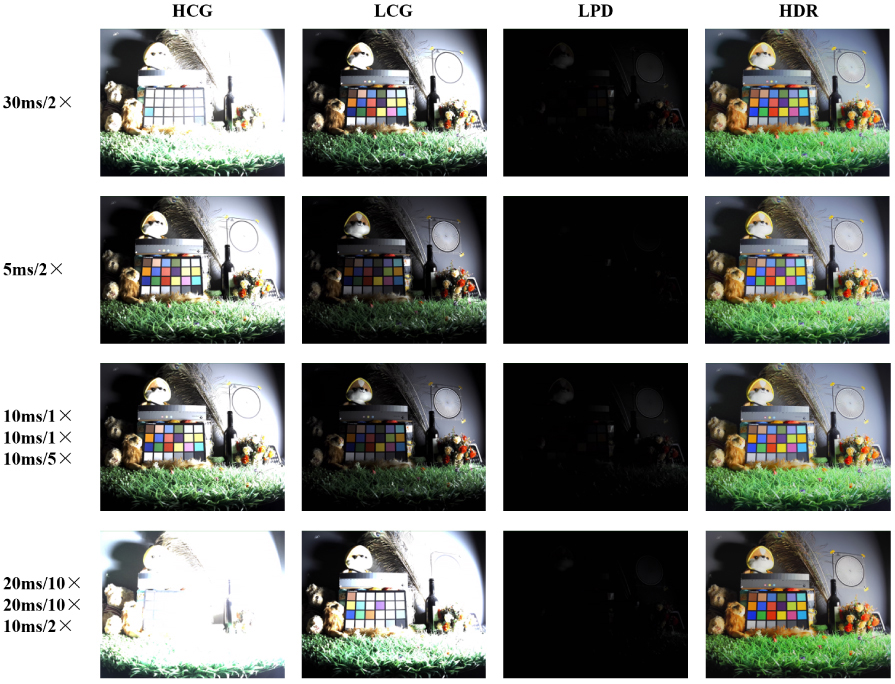
High dynamic range (HDR) imaging techniques effectively enhance image quality in driving scenarios. However, HDR image synthesis in automotive cameras remains challenging due to complex conditions such as high-contrast scenes, low-light environments, and vehicle motion. Automotive cameras typically optimize image quality by adjusting exposure time to control the duration of light capture and tuning analog gain to amplify the sensitivity of the imaging sensor. The study aims to identify the optimal parameter combinations of exposure times and analog gain settings for HDR image synthesis in automotive cameras. The authors acquire images at three frames captured under different exposure time and analog gain combinations and use HDR image synthesis techniques to simulate HDR images. A composite quality evaluation method was established based on four dimensions: tone range, tone levels, contrast, and signal-to-noise ratio. Quantitative analysis revealed that the best HDR image quality was achieved when the exposure time ranged from 5 ms to 20 ms and the analog gain ranged from 1× to 2×. The proposed HDR image synthesis strategy demonstrates significant practical value for automotive vision systems, improving image quality and providing more accurate and reliable visual information for autonomous driving and advanced driver-assistance systems, enhancing driving safety and user experience.
Xiangyang Xu, Chan Li, Shiting Xu, Caiyun Zheng, Zhicheng Zhang, "High Dynamic Range Image Synthesis Strategy for Automotive Cameras" in Journal of Imaging Science and Technology, 2026, pp 1 - 8, https://doi.org/10.2352/J.ImagingSci.Technol.2026.70.1.010407