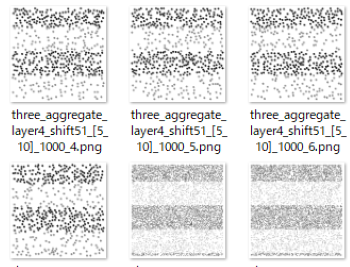
In this study, a novel method was developed to quantitatively evaluate the interactions between components in multi-component self-assembled structures. By combining multifractal analysis with mutual information from information theory, the effectiveness of this method was validated using simulated images of two-component structures. The analysis showed that the calculated mutual information correlates with changes in structural parameters, demonstrating that this technique can sensitively detect interaction strength. This approach is expected to become a powerful tool for microstructural analysis of multi-component systems, such as composite materials.
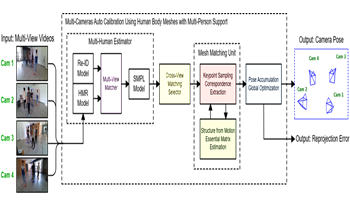
Human pose and shape estimation (HPSE) is a crucial function for human-centric applications, while the accuracy of deep learning-based monocular 3D HPSE may suffer due to depth ambiguity and occlusion problems. Multi-camera systems with wide baselines can mitigate the problems but accurate and robust multi-camera calibration is a prerequisite. The main objective for the project is to develop fast and accurate algorithms for automatic calibration of multi-camera systems which fully utilize human semantic information from multiple persons in the scene simultaneously seen by multiple cameras, without using predetermined calibration patterns or objects. The proposed method solves the multi-view matching problem by combining geometric consistency (represented by pose and shape from HPSE model) and appearance similarity (represented by feature from Re-ID model) to calculate the affinity scores between human body meshes detected from different views and then calculate the optimal permutation matrix P, which is cycle-consistent across all views for all persons seen by more than one camera. Humans seen by pairs of cameras and identified as the same person are further processed for pairwise camera calibration using Structure-from-Motion (SfM) and RANSAC algorithms to estimate the relative camera pose between the pair of cameras. The proposed method supports multiple persons in the common regions and achieves higher accuracy and faster convergence rate than existing methods using deep learning-based 2D human object detectors or 2D human joint estimators with iterative refinement for multi-person support.

In this paper, we propose the DSR-QBD framework, which integrates Deep Burst Super-Resolution (DBSR) with U-Net-based 2x2 OCL Quad-Bayer Demosaic. Traditional single-frame methods often struggle with the inherent disparity issues present in 2×2 On-Chip Lens (OCL) Quad-Bayer sensors. Our proposed framework addresses these challenges by treating a single 2×2 OCL image as multiple phase-separated frames, enabling the application of advanced multi-frame super-resolution techniques. Unlike conventional single-frame approaches, our method addresses the disparity issue in 2×2 OCL Quad-Bayer sensors by treating a single 2×2 OCL image as multiple phase-separated frames and applying multi-frame techniques. This strategy enables the effective utilization of phase images to enhance reconstruction quality. Furthermore, the integration of U-QBD within DSR-QBD mitigates the limitations of DBSR, particularly in correcting false pattern artifacts that may arise during reconstruction, thereby yielding more stable and natural results.