 Find this author on Google Scholar
 Find this author on PubMed


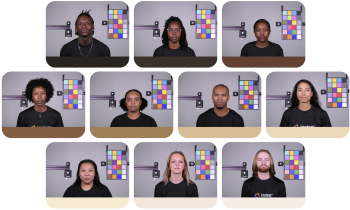
Photographic test charts for measuring color accuracy in cameras have historically included a limited number of skin tones, typically in the form of uniform color patches. Such charts are not representative of the wide range of skin tones found in humans, and do not test the behavior of modern automatic exposure, white balance, and focus (3A) algorithms that are commonly driven by facial detection in today’s digital consumer cameras. We built upon our previous work on the development of printed skin tone charts featuring detectable faces by conducting a study with human participants whose skin tones approximately span the Monk Skin Tone Scale. Participants were photographed under a series of controlled lighting conditions, and each scene was then reproduced using a high-resolution inkjet print of the participant. Corresponding captures of the human subjects and the printed charts were quantitatively compared by calculating the CIEDE2000 color difference for regions of interest across the subject’s face in the scene. This analysis evaluates how printed skin tones behave across exposure settings and lighting conditions relative to real skin, with the goal of determining whether printed charts provide a suitable solution for repeatable, lab-based image quality testing in face-present scenes. While not intended to replace final field testing with real human subjects, results indicate that face charts printed with sufficiently wide-gamut printers can provide an effective solution for lab testing and benchmarking of color accuracy and 3A behavior in a controlled and repeatable manner.
Megan Borek, Amelia Limbocker, Ellis Monk, "Validation of Skin Tone Test Charts with Real Human Data" in Electronic Imaging, 2026, pp 247-1 - 247-7, https://doi.org/10.2352/EI.2026.38..IQSP-247