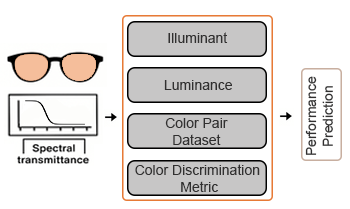
Tinted eyewear acts as a wavelength-dependent spectral filter in the visual chain and can alter both perceived color appearance and color discrimination, yet its perceptual impact is typically assessed only through physical transmittance or task-specific criteria. This paper proposes a theoretical and computational framework for evaluating tinted eyewear by integrating spectral transmittance with illumination spectra and luminance level. Color appearance changes are predicted using CIECAM16 attributes and bin-based gamut visualizations derived from the TM-30 Color Evaluation Samples, while discrimination performance is assessed for both small and large color differences and validated against behavioral data from two psychophysical experiments. Comparisons among CAM16-UCS color differences, CIEDE2000, HyAB, and cone-contrast metrics show that appearance-based measures effectively describe global color appearance changes, whereas cone-contrast–based metrics exhibit the strongest correspondence with behavioral discrimination performance. The framework provides a perceptually grounded basis for evaluating and comparing tinted eyewear across applications where both color appearance and visual performance are critical.
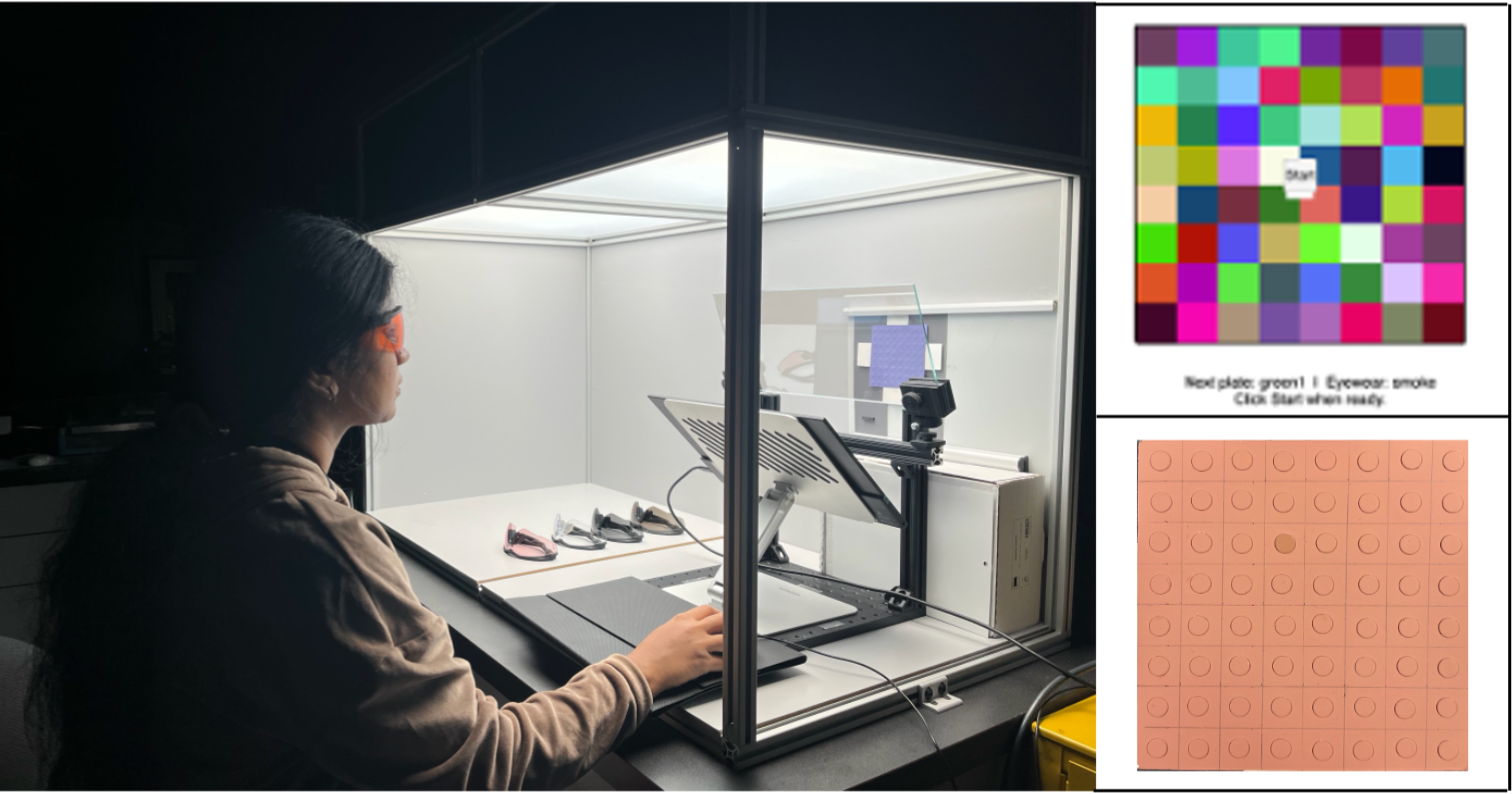
Tinted eyewear alters the spectral information reaching the human eye, potentially influencing visual performance in real-world tasks. Our previous work quantified changes in color discrimination ability under tinted eyewear using a psychophysical experiment. The present study extends this investigation by employing a visual search method to evaluate perceptual sensitivity. Two psychophysical experiments were conducted to evaluate visual performance under tinted eyewear: one focused on small color difference, assessed by reaction time and accuracy of target detection, and the other on large color differences, evaluating discrimination ability with increasing viewing distance. Overall, the results suggest that color appearance–based evaluations may help account for variations in task performance under tinted eyewear, particularly for small color difference stimuli. For large color difference stimuli, performance difference caused by tinted eyewear were observed, but the relationship between prediction and performance was not clear, which needs future investigation. By comparing the experimental data with model predictions, this study aims to provide a deeper understanding of the perceptual behavior changes caused by tinted eyewear.
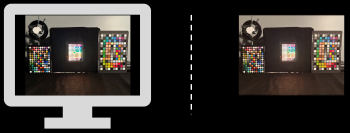
Reference-white placement is a central issue in HDR rendering because it determines the viewer’s adaptation state and strongly influences perceived color appearance. In HDR scenes that contain both reflective surfaces and bright emissive elements, it remains unclear how diffuse white should be placed on the display and how highlights should be tone mapped to preserve appearance. In this work, we investigate how reference-white placement and highlight tone mapping affect the perceptual reproduction of emissive colors in HDR scenes. To address this question, we captured a controlled HDR scene containing both reflective and emissive color targets and rendered it on a professional HDR display using different rendering strategies. These included varying the displayed diffuse-white luminance and comparing global tone mapping with selective processing of emissive regions. Due to scene complexities and the absence of standard color-difference metrics designed for such applications, our work relies on perceptual assessments. Observers viewed the real scene and then evaluated the display renderings in terms of appearance-based criteria. The results show that reference-white placement and tone-mapping strategy jointly influence perceived image quality and color appearance. In particular, the initial findings suggest that separately processing reflective and emissive regions—preserving colorimetric reproduction for reflective areas while compressing emissive highlights—produces the most favorable overall renderings.
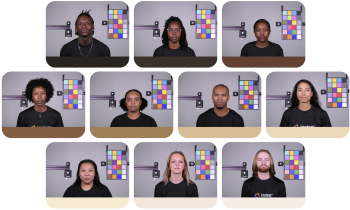
Photographic test charts for measuring color accuracy in cameras have historically included a limited number of skin tones, typically in the form of uniform color patches. Such charts are not representative of the wide range of skin tones found in humans, and do not test the behavior of modern automatic exposure, white balance, and focus (3A) algorithms that are commonly driven by facial detection in today’s digital consumer cameras. We built upon our previous work on the development of printed skin tone charts featuring detectable faces by conducting a study with human participants whose skin tones approximately span the Monk Skin Tone Scale. Participants were photographed under a series of controlled lighting conditions, and each scene was then reproduced using a high-resolution inkjet print of the participant. Corresponding captures of the human subjects and the printed charts were quantitatively compared by calculating the CIEDE2000 color difference for regions of interest across the subject’s face in the scene. This analysis evaluates how printed skin tones behave across exposure settings and lighting conditions relative to real skin, with the goal of determining whether printed charts provide a suitable solution for repeatable, lab-based image quality testing in face-present scenes. While not intended to replace final field testing with real human subjects, results indicate that face charts printed with sufficiently wide-gamut printers can provide an effective solution for lab testing and benchmarking of color accuracy and 3A behavior in a controlled and repeatable manner.

Lighting chromaticity plays a critical role in the visual perception of rendered content embedded within virtual scenes. Consequently, much effort is made to reduce differences in lighting chromaticity between these, to avoid an unnatural combined appearance. However, it is not currently known ”how” different these lighting conditions can be before people can notice them, or before it becomes detrimental to visual appearance. In this study, three psychophysical tasks are employed to assess participants’ perception of simulated lighting conditions applied separately to rendered virtual backgrounds and virtual objects, with a focus on stimuli comprising human faces. The tasks assessed the influence of object characteristics (variable skin tone), and differences in lighting chromaticity (between scenes and objects) on visual assessments for perceived lighting matches, mismatches, and preferences. Results revealed that both object and lighting characteristics significantly influenced each perceptual judgment, in different ways. Chromaticity matches, mismatches, and preferences for facial stimuli depended on the scene chromaticity and skin tone but their patterns varied across tasks. The current work can provide guidance for virtual rendering based on visual perception of simulated lighting differences.
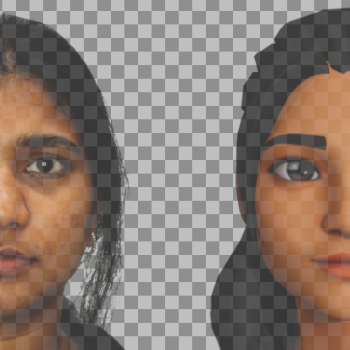
Optical see-through augmented reality (OST-AR) is a technology that allows humans to superimpose graphical elements over the natural environment through a transparent medium. When graphical elements are dark or ambient light is bright, color blending can cause graphical elements to appear transparent. In particular, graphical human faces that have darker skin tones appear more transparent than those with lighter skin tones, introducing both perceptual and social challenges. In this work, a psychophysical experiment assesses observers’ preferred renderings of skin tones in OST-AR. Observers were asked to adjust the lightness of faces superimposed by OST-AR glasses under a bright ambient lighting condition. The stimuli comprised photos of real faces, their corresponding digital avatars, and included those representing the observer and zero-acquaintance targets. We found that observers tended to increase lightness more as faces became darker for both real faces and avatars, but that this pattern was not evident when adjusting photos of their own faces. These results indicate that color preferences for facial color in OST-AR may operate differently depending on familiarity with the target being evaluated, indicating a need for further research involving self-representative stimuli.
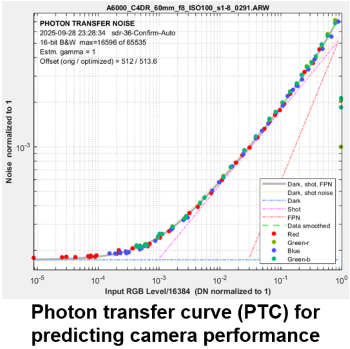
We present an image sensor noise model that can be used in a complete image system simulation that includes image generation, lens degradations, and ISP (Image Signal Processing), and can produce classic measurements (SFR, noise, etc.) as well as new information metrics such as information capacity and SNRi. The noise model is derived from a classic Photon Transfer Curve (PTC) obtained from one or more raw (undemosaiced) images of a high dynamic range grayscale test chart. Image sensor noise is composed of three factors. 1. Dark noise, which includes electronic noise, dark current noise, DSNU fixed-pattern noise, and noise from several other sources. It is independent of signal amplitude, A. 2. Photon shot noise, which varies with √𝐴, and 3. PRNU fixed-pattern noise, which varies linearly with A. The coefficients for the three factors are determined using a Levenberg Marquardt optimizer that provides an extremely close fit between the measured data and the calculated PTC. The coefficients can also be derived from EMVA 1288 measurements, which are more accurate and detailed, but require the acquisition of a large number of images. We show how the model can predict performance over a wide range of conditions, and most importantly, for low light.
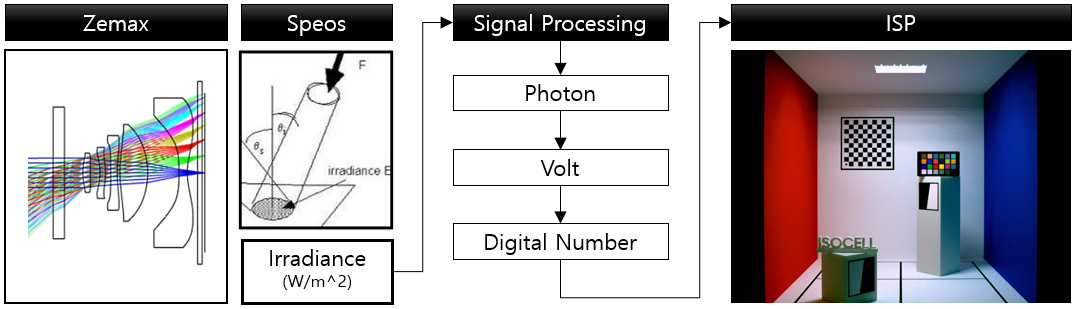
This paper presents the development of an end-to-end digital twin system for CMOS Image Sensors (CIS) by leveraging Ansys Zemax, Speos, and Lumerical. We extracted the geometric and material data of an actual smartphone camera lens using Zemax, and calculated the irradiance post-lens through Spectral-based ray tracing simulations in Speos. Subsequently, Lumerical was utilized to precisely model pixel-level Quantum Efficiency (QE) across various wavelengths and optical fields, culminating in the generation of simulation-based digital images. The reliability and accuracy of this model were validated in a Cornell box-based environment by comparing the consistency of ESF, chromatic aberration, distortion, and chromaticity (CIE 1931) between experimental captures and digital twin simulations.
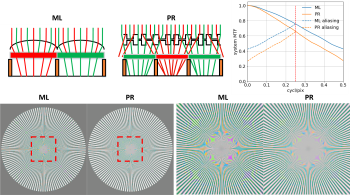
Photon router technology is emerging as a novel approach that replaces microlenses to boost CMOS image sensor signal-to-noise ratio. It provides an approach to solve the signal-to-noise ratio drop associated with the trend of pixel size reduction. To comprehensively understand the photon router image sensors overall image quality, it is critical to study the modulated transfer function and aliasing effect. In this study, we show that photon routers exhibit lower sensor MTF compared to the microlenses due to its higher effective fill factor. Our image simulations show that photon routers present less severe aliasing artifacts compared to the microlenses. We show that it is because lower MTF of photon routers leads to lower aliasing components. Furthermore, we present that the reduced resolution in the photon router image can be effectively compensated through tuning sharpening parameter in the image signal processing, enabling comparable sharpness. Our findings highlight the trade-off between achieving high signal-to-noise ratio and high modulated transfer function for photon routers and provide design insights for next-generation high-performance CMOS image sensors.
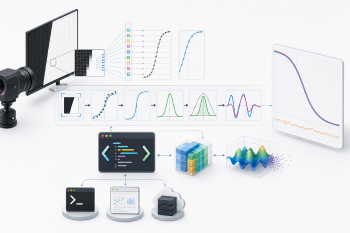
ISO 12233 defines the slanted-edge technique for estimating the spatial frequency response (SFR) of imaging systems. SFRMAT, originally developed by Burns, has served for over two decades as the de facto MATLAB implementation of this standard. This paper presents a fully open-source Python implementation of SFRMAT5 with equivalent functionality and numerical fidelity. The software mirrors the original MATLAB structure to simplify maintenance and coexistence, while supporting CLI, GUI, and headless operation. Validation against the MATLAB version demonstrates practical numerical equivalence (< 10−10) on real captures where valid outputs are available. The implementation enables broader adoption in research, education, and production imaging pipelines and is available at burnsdigitalimaging. com/ software/ sfrmat .