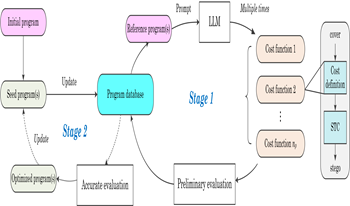
In this paper, we make the first attempt towards defining cost function of steganography with large language models (LLMs), which is totally different from previous works that rely heavily on expert knowledge or require large-scale datasets for cost learning. To achieve this goal, a two-stage strategy combining LLM-guided program synthesis with evolutionary search is applied in the proposed method. In the first stage, a certain number of cost functions in the form of computer programs are synthesized from LLM responses to structured prompts. These cost functions are then evaluated with pretrained steganalysis models so that candidate cost functions suited to steganography can be collected. In the second stage, by retraining a steganalysis model for each candidate cost function, the optimal cost function(s) can be determined according to the detection accuracy. This two-stage strategy is performed by an iterative fashion so that the best cost function can be collected at the last iteration. Experiments show that the proposed method enables LLMs to design new cost functions of steganography that significantly outperform existing works in terms of resisting steganalysis tools, which verifies the superiority of the proposed method. To the best knowledge of the authors, this is the first work applying LLMs to the design of advanced cost function of steganography, which presents a novel perspective for steganography design and may shed light on further research.
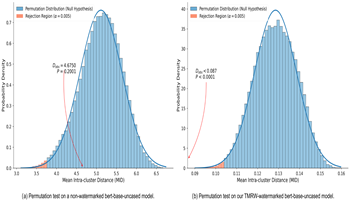
Protecting the intellectual property of natural language encoders faces a critical challenge: hidden watermarks are easy to be erased when models are fine-tuned to adapt to downstream applications, known as “task migration”. To deal with this problem, we introduce a Task Migration Resistant Watermarking (TMRW) framework to strengthen the watermark robustness against task migration. The proposed method uses a dual-objective fine-tuning strategy. During the process of watermark embedding, a specifically designed watermark loss function is introduced to compel the encoder to map a set of trigger inputs into a compact cluster in the embedding space. To counteract the potential performance degradation introduced by this process, an augmented contrastive loss is simultaneously optimized to preserve the encoder’s general semantic representation abilities. This dual-objective strategy is further enhanced by a novel trigger corpus crafting method that ensures the watermark’s stealthiness. Experimental results show that the proposed method enables the embedding of a robust watermark that significantly outperforms existing techniques in resisting erasure from task migration. This work well deals with the challenge of encoder watermark’s durability against task migration, which provides a novel and practical framework for intellectual property protection in natural language processing systems.
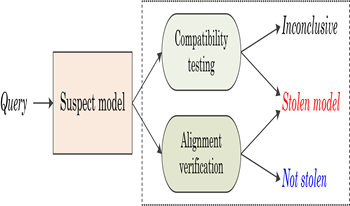
Recent advances confirm that large language models (LLMs) can achieve state-of-the-art performance across various tasks. However, due to the resource-intensive nature of training LLMs from scratch, it is urgent and crucial to protect the intellectual property of LLMs against infringement. This has motivated the authors in this paper to propose a novel black-box fingerprinting technique for LLMs. We firstly demonstrate that the outputs of LLMs span a unique vector space associated with each model. We model the problem of fingerprint authentication as the task of evaluating the similarity between the space of the victim model and the space of the suspect model. To tackle with this problem, we introduce two solutions: the first determines whether suspect outputs lie within the victim’s subspace, enabling fast infringement detection; the second reconstructs a joint subspace to detect models modified via parameter-efficient fine-tuning (PEFT). Experiments indicate that the proposed method achieves superior performance in fingerprint verification and robustness against the PEFT attacks. This work reveals inherent characteristics of LLMs and provides a promising solution for protecting LLMs, ensuring efficiency, generality and practicality.
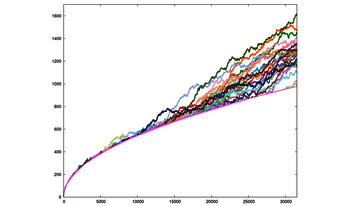
This paper proposes Uniform Switching Identities (USWIDs) as a lightweight, collusion-resistant identity scheme designed for computationally constrained environments. USWIDs use uniformly structured identities and simplified penalization logic while retaining effectiveness comparable to classical Tardos-based methods. Through simulations, we show U-SWIDs maintain robustness even under lossy feedback conditions - common in forensic watermarking scenarios. Compared to Approximated Tardos Switching Identities (AT-SWIDs), U-SWIDs offer improved scalability, ease of generation, and operational simplicity without compromising traceability. The findings suggest U-SWIDs are a viable alternative for practical traitor tracing systems, especially where delivery, derivation cost, and resilience to partial symbol loss are critical deployment factors.

Face swapping techniques enable the realistic manipulation of facial identities across images, posing significant challenges for digital forensics. While existing research has focused on detecting manipulated media, little attention has been given to identifying the specific source image used in a face swap. In this work, we investigate whether it is possible to reliably trace a manipulated image back to the exact photo that served as the source for the swapped face. We propose a comparison-based method that generates candidate face swaps using known source images and compares them to the target manipulation. Experiments data set demonstrate that our method identifies the correct source image based. We further evaluate robustness against common image distortions, such as JPEG compression and down-scaling, and find that the identification process remains reliable. Our findings highlight the potential of image-level forensic analysis to support source attribution in face-swapped media, with important implications for legal and investigative contexts.
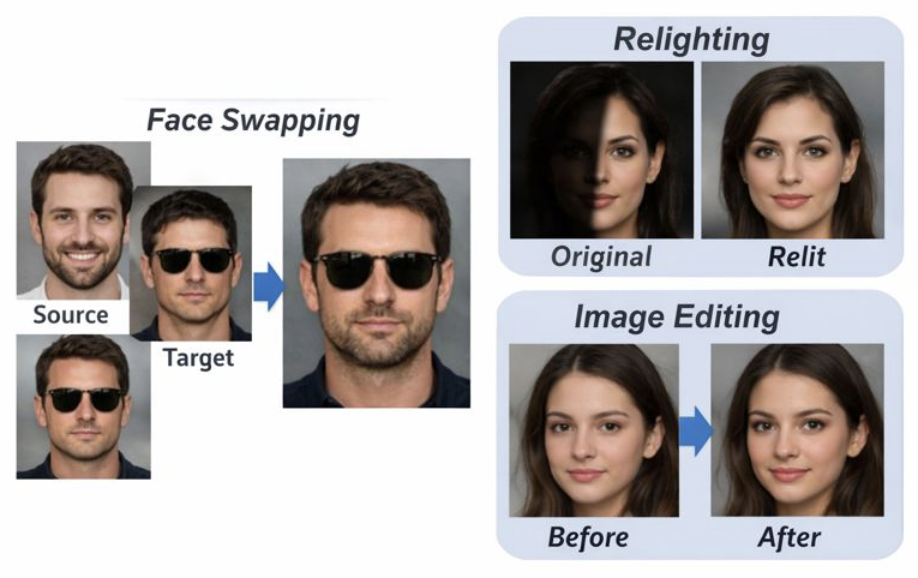
Face swapping, or deepfake generation, remains a challenging task that requires balancing identity preservation, attribute consistency, and photorealistic realism. We propose a novel training-free, three-stage face swapping framework that improves realism by explicitly aligning illumination and skin appearance prior to diffusion-based synthesis. Our approach refines photometric consistency and skin tone while preserving facial structure and integrates seamlessly with an off-the-shelf diffusion face swapping model. Experiments on the CelebAMask-HQ dataset demonstrate significant improvements in both visual realism and attribute preservation, achieving an FID score of 7.16 compared to the baseline. The proposed method provides an efficient and robust solution for realistic face swapping under varying illumination and appearance conditions without additional model training.

Cultural artifact classification supports preservation, scholarship, and anti-trafficking enforcement, but computational approaches face severe data scarcity: limited labeled collections, inconsistent metadata, and complex annotation requirements. We present a methodology for large-scale dataset creation from aggregated heritage platforms that combines cultural marker extraction from unstructured text descriptions, cross-lingual querying across multiple European languages, visual clustering using self-supervised features, and collection-aware data splitting. Applied to Europeana, this produced datasets ranging from 33,859 to 310,252 objects across 6 to 62 classes of varying granularity. Visual clustering removed 34% of noisy content while enabling fine-grained subcategories. A k-nearest-neighbor probe of the resulting feature space revealed that 79.5% of nearest neighbors share the same institutional source. This nearly matches the 83.0% same-civilization rate, indicating that institutional signatures are almost as dominant as cultural content. We quantify this bias per civilization and propose collection-aware splitting as a necessary countermeasure for realistic evaluation.