 Find this author on Google Scholar
 Find this author on PubMed


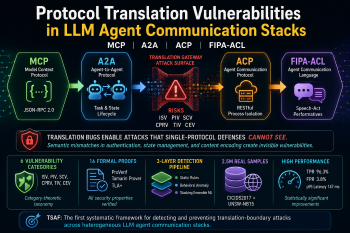
As autonomous LLM agents increasingly operate across heterogeneous communication stacks — MCP, A2A, ACP, and FIPA-ACL — the translation gateways that bridge these protocols constitute a critical yet largely unstudied attack surface. Semantic mismatches in authentication, state management, and content encoding at translation boundaries can enable vulnerabilities that are invisible to single-protocol defenses. We introduce the Translation Security Analysis Framework (TSAF), contributing a six-category vulnerability taxonomy (ISV, PIV, SCV, CPRV, TIV, CEV) grounded in category theory, a three-layer detection pipeline combining static rules, behavioral anomaly detection, and a stacking ensemble classifier (XGBoost, LightGBM, HistGBM) trained on 2.5 million real network traffic samples from CICIDS2017 and UNSW-NB15, and formal verification of 16 security properties via ProVerif, Tamarin Prover, and TLA+—all proved to hold. Evaluation yields 96.3% true positive rate, 3.8% false positive rate, and 147 ms p95 latency, with statistically significant improvements over all baselines. TSAF provides the first systematic treatment of translation-boundary attacks in multi-agent AI.
Mahipal , "Protocol Translation Vulnerabilities in LLM Agent Communication Stacks" in Electronic Imaging, 2026, pp 320-1 - 320-12, https://doi.org/10.2352/EI.2026.38.3.MOBMU-320