 Find this author on Google Scholar
 Find this author on PubMed


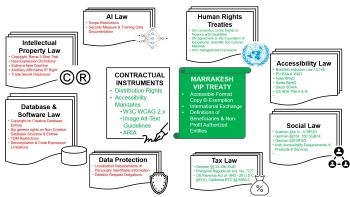
With 126 signatories as of 2025, the Marrakesh VIP Treaty is one of the most far-reaching international legal treaties and enables blind and visually impaired people and authorized entities acting on their behalf lawful access to copyrighted intellectual property by legitimizing creation of so-called accessible format copies. However, on the explicit topic of image-to-text transformation or text-and-data mining now made possible by advanced vision language models (such as BLIP-2, LLaVA-1.5-7B, Moondream2, Qwen2-VL-2B, and Idefics3-8B), the treaty is silent. This work provides a comparative analysis of the developments in the tangential legal frameworks of several countries as well as various conference and scientific journal publishing frameworks to highlight the permissibility of visually impaired users of scientific literature to overcome the “book famine” they face. These legal challenges and opportunities are exemplified for the various stakeholders in the scientific publishing domain. Furthermore, the paper explores conflict potentials with data-mining restriction laws and sui generis database rights. The paper ends with an outlook assessing the maturity of the current conference proceedings landscape for enabling legally compliant access to the visually impaired.
Frank Wittig, Ruthra Bellan, "Enabling Factors of International IP Treaties for Unlocking Scientific Publication Image Capture for the Visually Impaired" in Electronic Imaging, 2026, pp 314-1 - 314-17, https://doi.org/10.2352/EI.2026.38.3.MOBMU-314