 Find this author on Google Scholar
 Find this author on PubMed


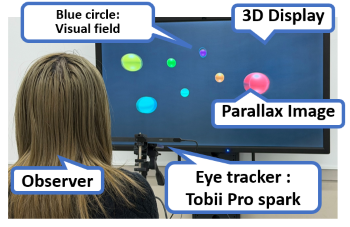
Autostereoscopic 3D displays often suffer from inadequate depth perception and visual discomfort due to fixed convergence angles and the vergence–accommodation conflict. This study proposes a novel lenticular-based naked-eye 3D display system that enhances depth perception by dynamically adjusting parallax images using the observer’s real-time gaze data. By generating a pseudo-convergence angle aligned with the viewer’s point of interest, the system aims to provide more accurate and comfortable 3D visualization. An experiment was conducted to evaluate the effectiveness of the system by comparing it with a conventional (fixed-parallax) 3D display and a standard 2D display. Participants judged the depth order of eight spheres in a computer-generated scene. Results showed that the proposed method significantly improved depth perception accuracy, reducing the mean absolute error by approximately 50% compared with the 2D display and by 20% compared with the conventional 3D display. These findings demonstrate that gaze-contingent parallax adjustment is a promising approach for mitigating the inherent limitations of autostereoscopic displays and improving the user experience.
Yoshihiro Sato, Mirika Yamashiro, "Implementation of Pseudo-convergence Angle in Eye Tracking for CG-based Lenticular Naked-eye 3D Displays" in Electronic Imaging, 2026, pp 333-1 - 333-5, https://doi.org/10.2352/EI.2026.38.2.SDA-333