
This paper provides a summary of the 37th annual Stereoscopic Displays and Applications (SD&A) conference held in March 2026, and also introduces the SD&A 2026 conference proceedings.
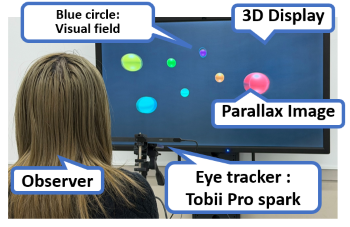
Autostereoscopic 3D displays often suffer from inadequate depth perception and visual discomfort due to fixed convergence angles and the vergence–accommodation conflict. This study proposes a novel lenticular-based naked-eye 3D display system that enhances depth perception by dynamically adjusting parallax images using the observer’s real-time gaze data. By generating a pseudo-convergence angle aligned with the viewer’s point of interest, the system aims to provide more accurate and comfortable 3D visualization. An experiment was conducted to evaluate the effectiveness of the system by comparing it with a conventional (fixed-parallax) 3D display and a standard 2D display. Participants judged the depth order of eight spheres in a computer-generated scene. Results showed that the proposed method significantly improved depth perception accuracy, reducing the mean absolute error by approximately 50% compared with the 2D display and by 20% compared with the conventional 3D display. These findings demonstrate that gaze-contingent parallax adjustment is a promising approach for mitigating the inherent limitations of autostereoscopic displays and improving the user experience.
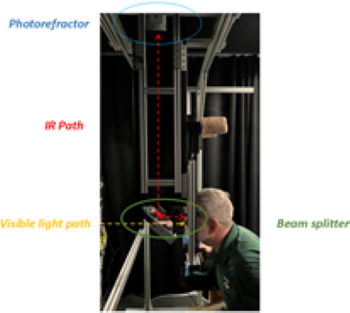
When viewing a stereoscopic 3D (S3D) display, the stimuli for binocular vergence (binocular disparity) and accommodation (defocus) are often in disagreement, leading to vergenceaccommodation conflict (VAC). This is likely a significant source of discomfort and greatly affects the usability of such displays. One possible oculomotor strategy to mitigate the strain from VAC is to constrict the pupil, which serves to increase the depth of focus and reduce accommodative demand. The goal of this investigation was to analyze the relationship between by accommodation, vergence and pupil response while performing a precision depth task using an S3D display with varying degrees of VAC. Over the course of one-hour epochs, refractive error, vergence posture and pupil size were recorded at 50 Hz using an eccentric photorefractor. We found multiple strategies for mitigating VAC, including the dampening of the accommodative response and the recruitment of pupil miosis. Though this likely served to relax VAC, not all participants employed this oculomotor strategy, suggesting individual differences that may relate to general discomfort and usability.
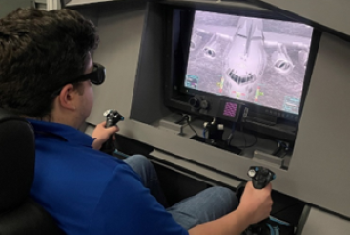
With increased use of stereoscopic devices, it is important to emulate real-world practices and study physiological and perceptual effects over long viewing periods. Stereoscopic channels may not always be perfectly aligned, and alignment may shift with use. In this experiment, we investigated the impact of vertical misalignment between left and right-eye imagery during stereoscopic remote vision system (sRVS) use. For three-hour periods, participants performed a simulated aerial refueling task. Their goal was to fly the boom into a receiver aircraft receptacle as quickly as possible without scratching the aircraft. After each successful connection, the participant monitored several systems, which required changes to version and vergence position. Binocular eye position was recorded throughout the task. While performance increased over time, the survey results showed that participants were experiencing strain over time and with increased misalignment. However, only one oculomotor change – horizontal vergence – was observed over time. Time series analysis revealed a more complex relationship between pupil size and time within each block. To further investigate the relationship between eye movement behavior and vertical misalignment, a principal component analysis was performed. These results identified eye movement behaviors that are sensitive to changes in stereoscopic misalignment and have the potential to be used to indicate oncoming fatigue. This experiment highlights the importance of considering the visual system as a whole when assessing stress and not simply relying on performance metrics.
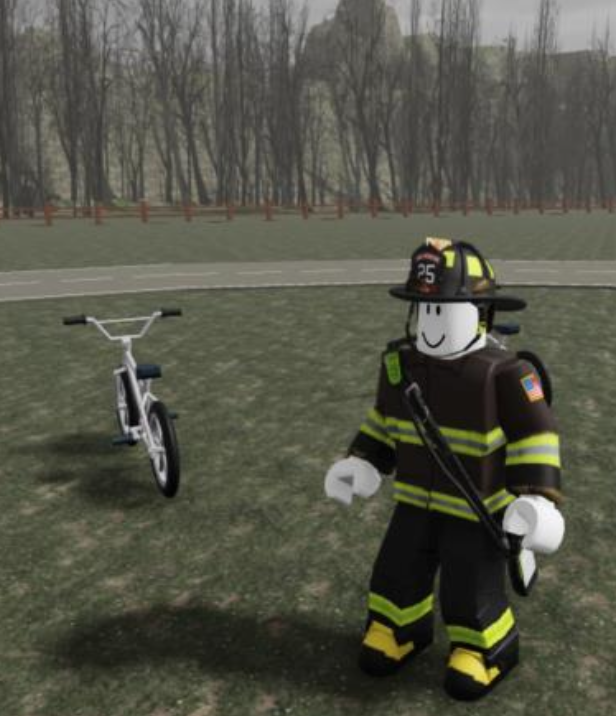
Anhedonia is a psychological condition defined as the reduced capacity to experience pleasure with an increase in emotional numbness. Anhedonia, while not popular by name, is a commonly met symptom associated with post-traumatic stress disorder (PTSD), depression, and anxiety. This condition is increasingly understood as a deviation in the brain’s reward processing system, particularly in the anticipatory and consummatory phases. Research suggests that emotional numbing and chronic stress occurs when dopamine pathways and motivational drive are disrupted. In this paper, a deep dive is taken into how Virtual Reality immersive programs, used in exposure therapy for treating anxiety disorders, can be adapted and programmed to specific scenarios that may help induce anhedonic states. The paper uses the Unpredictable Chronic Mild Stress (UCMS) model in animals to propose that VR scenarios simulating sensory deprivation and emotional desensitization stressors may replicate core features of anhedonia. Virtual platforms can be used to mimic disruptions in the hypothalamicpituitary-adrenal (HPA) axis and reward circuitry. Why is inducing anhedonia worth exploring? Inducing anhedonia in a controlled VR environment can help study whether this temporary psychological state can act as a bridge that can be used to mitigate negative reactions in humans, such as claustrophobia. When a subject experiences a temporal emotional numbing, it gives researchers the ability to reduce the emotionally heightened reactions commonly triggered by confined spaces. Ultimately, this research offers a novel direction in the use of VR: not only as a therapeutic tool but also as a controlled experimental medium to investigate emotional numbing and reward dysfunction.

Mixed reality (MR) integrates virtual content with the physical world, enabling users to place virtual objects in real environments and interact with or observe them. As MR technologies advance, such experiences are becoming increasingly common. However, it remains unclear how the visual and interactive representation of virtual objects influences users, and few studies have examined users’ behavioral responses to virtual objects. We investigated whether representation factors (interactivity, transparency, and size) affect users’ sense of presence and their behaviors toward the object (e.g., avoidance or displacement). Here, interactivity refers to whether users can touch the virtual object. In two experiments (desk-scale and room-scale) conducted, participants performed a reaching task toward a real target located behind a virtual object whose representation factors were manipulated. Presence and behavior were assessed using subjective ratings and objective measures from tracking data and video observations. Perceived presence varied with interactivity, transparency, and size, whereas avoidance and displacement behaviors showed no reliable differences across conditions. Nonetheless, the results suggest that behavioral responses may emerge when interaction demands are stronger or the scale of interaction is larger. Overall, representation affected perceived presence but did not reliably change avoidance or displacement behavior in this task.
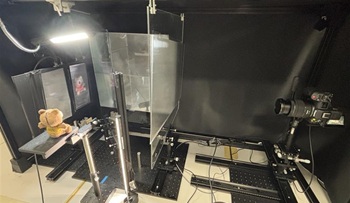
Conventional light-field (LF) cameras are typically limited to narrow viewing angles for capturing light rays emitted from objects. We proposed an aerial-imaging light field (ALF) camera that forms aerial images of objects and captures them via a lens array with wide viewing angles. Using a prototype lenticular lens array, we achieved a 36.1° viewing angle and captured more horizontal perspectives. The elemental images were then input into an integral 3D display with the same lens array, allowing real-time, glasses-free 3D image display. Based on this functionality, we developed a prototype real-time 3D video communication system combining an ALF camera and an integral 3D display.

The use of Virtual Reality (VR) in education is rapidly increasing due to the immersive and interactive environments it provides that support the nature of engineering learning experiences that can be difficult, hazardous, or resource-intensive. However, this rapid growth of VR-based educational systems has produced a fragmented literature. This paper presents a scoping review of 32 peer-reviewed studies published between 2012 and 2025 that examine the use of VR in engineering education contexts. Using a structured extraction and descriptive synthesis approach, the review analyzes trends across engineering domains, learning objectives, VR modalities, instructional roles, learner populations, and evaluation methods. The results reveal a strong emphasis on procedural learning objectives, including laboratory skill rehearsal, equipment operation, and safety-oriented training. Despite this focus on procedural tasks, evaluation practices are frequently limited to short-term, perception-based measures, highlighting a structural misalignment between learning objectives and assessment methods. Furthermore, VR is most often deployed as a supplementary instructional tool rather than as a fully integrated component of course design.

Immersive VR tools simulate cosmic events interactively to improve understanding of space science, but they often prioritize visuals over learning. MAIVE navigates virtual environments with multiple AI agents and embedded tutors on demand. A central coordinator guides these tutors in explaining concepts, checking assumptions, and providing step-by-step support. By aligning motion data with activity milestones, the system captures signals that show how each user progresses through tasks. Conversation history is preserved by a memory and retrieval tool to support teachers. Separating perception tasks from teaching moves and internal model updates allows adjustments without changing virtual environments. To measure impact, we will compare an adaptive MAIVE condition to a nonadaptive condition using the same material, order, and logging. We will analyze conceptual change, user feedback scores, pause, help, and error logs.
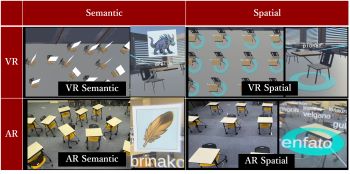
As extended reality (XR) technologies in education—particularly Augmented Reality (AR) and Virtual Reality (VR)—advance rapidly, there is a growing need to understand how these platforms influence cognitive learning processes. Vocabulary acquisition, a core aspect of second-language learning, relies heavily on memory strategies. However, it remains unclear how platform-specific features, such as contextual anchoring in AR or spatial immersion in VR, interact with different strategies to affect learning outcomes. This study examines how two key memory strategies, semantic association and spatial positioning, perform in AR and VR environments during second-language vocabulary learning. Specifically, it investigates whether a strategy–platform compatibility exists, in which certain strategies may be more effective depending on the platform’s cognitive affordances.