 Find this author on Google Scholar
 Find this author on PubMed


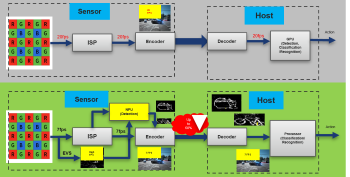
Automotive vision is a key component of advanced driver assistance systems (ADAS), enhancing road safety and improving vehicle operation for drivers. A critical requirement for automotive vision is achieving faster detections to ensure higher levels of safety. However, faster object detections using CMOS Image Sensors (CIS) are limited by their frame rate. While increasing the CIS frame rate enables faster object detection, it also results in higher sensor data rates and significantly increases power consumption. In our previous work, we demonstrated that utilizing event-based pixels—offering sparse spatial resolution but high temporal resolution—with low CIS framerate provides an effective alternative solution for faster object detections in automotive vision. Using hybrid sensor data (low CIS framerate + event-based sensor (EVS)) achieves comparable performance to high CIS framerate but with reduced data rates and power consumption. Specifically, in our previous study, we showed that using 7 fps CIS data combined with EVS data delivers the same performance as 20 fps CIS data, but with 40% lower data rate. In this work, we implement post-training quantization (PTQ) and quantization aware training (QAT) techniques to automotive vision models trained on hybrid sensor data (CIS+EVS). This enables automotive vision models using hybrid (CIS+EVS) sensors to reduce both sensor data rates and power consumption during inference, particularly when deployed on Neural Processing Units (NPUs).
Sean Fausz, Kamal Rana, Austin Xiong, Shijie Xiao, Zhongyang Huang, Bo Mu, "Low Power Automotive Vision Using Hybrid Sensors on NPUs" in Electronic Imaging, 2026, pp 108-1 - 108-6, https://doi.org/10.2352/EI.2026.38.16.AVM-108