 Find this author on Google Scholar
 Find this author on PubMed


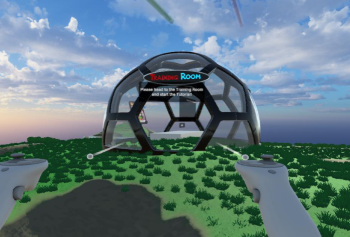
Extended Reality (XR) virtual environment (VE) development is heavily focused on visual models, artifacts and interactions. This reliance on visuals in augmented, virtual, or mixed reality (i.e., AR, VR, or MR) can reduce clarity and overload cognitive resources, especially for uses in education and training, for learners with diverse sensory needs. The next most straightforward sensory modality to add is sound, which is often limited to a passive background effect. However, with research minded implementation from the field of psychoacoustics, sound can be used as an effective interaction method in a VE, while simultaneously increasing effects such as presence and immersion. This research describes the development challenges and solutions encountered in building spatial audio as an active, instructional feedback tool in a STEM focused VR environment. The VE was designed to introduce middle and high school students to basic concepts of how the Internet functions (e.g., IP addresses, data packet routing). By embedding meaningful auditory cues and feedback, the system supports learners by reinforcing task completion and guiding attention. The sound design leverages psychoacoustic principles and spatialization techniques, which were iteratively refined with learner and expert input.
Rhoda Asamoah, Alex Renner, Kexin Wang, Kimberly Zarecor, Merate Barakat, Eliot Winer, Aidan Link, Jacqueline S. Lopez, Vanina J. Ngeumsop Feutie, "Use of Psychoacoustics for Improved Interaction and Navigation Capabilities in Extended Reality" in Electronic Imaging, 2026, pp 193-1 - 193-6, https://doi.org/10.2352/EI.2026.38.13.ERVR-193