 Find this author on Google Scholar
 Find this author on PubMed


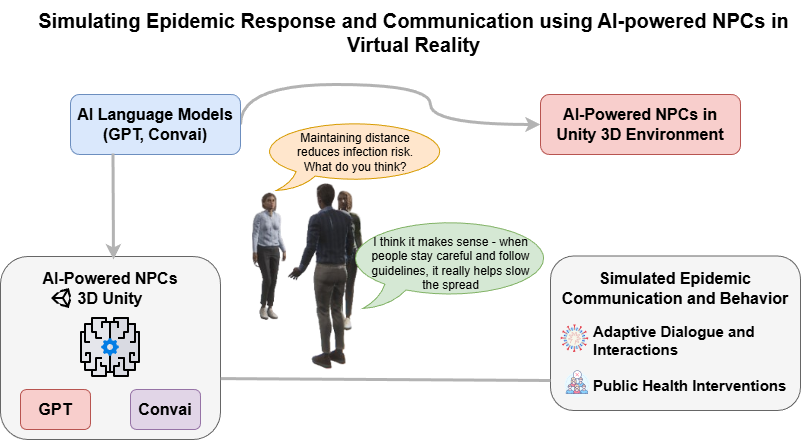
This study introduces a simulation framework designed to examine epidemic communication and behavioral interventions utilizing AI-driven non-player characters (NPCs) within a 3D environment created in Unity. The framework rectifies the limitations of conventional epidemiological models by integrating various agents that exhibit adaptive and context sensitive decision-making capabilities. Agents employ large language models (LLMs) and behavior trees to facilitate realistic conversations and responses in epidemic scenarios, contrasting with static rule-based systems. This results in interactions that closely resemble real-world human communication. The simulation enables real-time communication between agents and users in natural language. There are different ways that public health interventions, like social distance measures and communication attempts, can be used and evaluated. The technology enables agents to know what’s going on around them and how far away other people are, so they can act in the right way. The rendering engine in Unity makes the game more realistic, which makes it more interesting and useful. This study shows that agents were able to take part in COVID-19-related conversations using GPT and Convai and give appropriate answers to user questions. The framework makes it easy to do experiments on a large scale and can be used in many different public health settings. Future improvements will include simulating emotional states, making agents more diverse, and adding visual health indicators. This study introduces a scalable, ethical, and interactive instrument intended for researchers to examine human behavior, decision making, and intervention outcomes in simulated epidemic scenarios.
Faria Alam, Sharad Sharma, Pretom Roy Ovi, K. S. M. Tozammel Hossain, "Simulating Epidemic Response and Communication using AI-powered NPCs in Virtual Reality" in Electronic Imaging, 2026, pp 190-1 - 190-6, https://doi.org/10.2352/EI.2026.38.13.ERVR-190