YOLOv5YOLOv8yoloYou only look once v3 (YOLOv3)YouTubeYOLOXYou only look once (YOLO)YOLO-RYOLOYolov5
Z
Zero Parallax SettingZoom FatigueZ numberZERNIKEZEISSZernike polynomialZebra EmbryoZERNIKE MOMENTSZ-type SchlierenZero-Shot Classification
0
0.8um pixel
1
100 Hue test1/f noise108 Megapixel1-bit matrix completion180 degree images133-MEGAPIXEL1 MICRON PIXELS1st and 2nd FM generation 3D halftoning
2
2D printing2D-TO-3D CONVERSION ARTIFACTS2-D barcodes2AFC2.5D2D2D AND 3D CONVERTIBLE DISPLAY2.5D printing2.5D PRINTING2D/3D imaging, high performance computing, imaging systems, efficient computations and storage2.5 D printing2D-plus-depth video2D and 3D video2-d scale2D metrics2D to Hologram conversion2D DCT2D VIEWS2.5D reconstruction
3
3D STIMULI3d video3D IMAGE3D encoding3D3D vision3D surface structure based halftoning3D glasses3D COMPRESSION AND ENCRYPTION3D Reconstruction3D Color Printing360-degree imaging3d3D Range Data Encoding3D-printing3D USER INTERFACES3D TV3D cinema and TV360-Degree Video Technology3D PROFILE3d mapping360x3D scene capture3-D SHAPE RECOVERY3A ALGORITHMS360 Video3D visual representation3D-high efficiency video coding3D DISPLAY3D audio3D imaging3D ACQUISITION ARCHITECTURE3D INTERACTION360° VIDEO3D printer3D RECOVERY3D Print Appearance3D colour Digital Image Correlation3D localization and mapping3D digitization and dissemination3D range geometry3D/4D SCANNING3D localization3D-assisted features3D-Anisotropic smoothing3DCNN3D Scene Reconstruction and Modeling3D human-centered technologies3D point cloud3D mesh simplification35MM FILM DIGITIZATION3D projector3D Models3D Computer Graphics3D Compression3D object shape360-deg quality assessment360-DEGREE IMAGE3D shape analysis3D Quality3D Video Conferencing3D Image Processing3D RANGE IMAGING3-D RECONSTRUCTION3D MODELLING3d localization3D and 2D3D SCENE RECONSTRUCTION AND MODELING3D SHAPE INDEXING AND RETRIEVAL3D SALIENCY3D Meshes3D Video3-T pixel3D recursive search3D-human body detection3D halftoning3D print3DMM3D VISUALIZATION3D Compression and Encryption3D reconstruction3D MESH3D Iterative Halftoning360° STEREO PANORAMAS3D Lidar3D Scene Reconstruction3D-CNN3DSR3D communications360-degree video3D displays3D MESHES3D Display360-degree3D Gaussian splatting3D video processing3D scene classification3D objects3D warping3D surface3D Saliency3D optical scans3D data processing360-video360-degree video streaming3D depth-map3D mapping and localization3D/4D Data Processing and Filtering360VR3D/4D Scanning3D video3D-LUT360-degree image projection360 degrees video360-degree art exhibition3D CAMERAS3D perception360 panorama3D stereo vision3D Morphable Model360-degree images3D Object Detection3D MODEL3D face alignment3D PRINTING3D theater program listing3D Measurement3D-shooting3D position measurement of people3D DIGITIZATION METHOD FOR OIL PAINTINGS3D Telepresence3D Data Processing3D shape indexing and retrieval3D mesh3D-color perception3D display3D refinement3D HALFTONING360 IMAGING360° video3D Curvelet3ARRI footage3D range scanning3D depth sensing3D/2D Visuals3D modeling3D RECONSTRUCTION3D rigid transformations3D Vision3D Immersion3D digital halftoning3D Range Data Compression360 degree images3D modelling3D capture3D Mapping3D scanning3D Printing3D recovery3D affine transformation3D Point Cloud3D printing360-degree content3D Communications3D PRINTER3D shape3D image compression3D Digital Image Correlation3D camera3D Data Sources3D Halftoning3D adaptive halftoning3D-HEVC3D connected tube model3D scene flow estimation360-degree videos3D Shape Indexing and Retrieval3D/4D DATA PROCESSING AND FILTERING3D Video Communications3D EDUCATIONAL MATERIAL3D Tracking3D Range Data3D surface reproduction3D STACK3D Modeling3D TRANSFORMATION3D Imaging3D compression3D model360-degree Image
4
4K4D PRINTING4-AFC Experiment4K resolution4D scanning4D-printing4T PIXEL4D hyperchaos system
6
6-DOF60 GHz Wireless6D pose estimation6DoF
7
7-1 MICRON PIXELS
8
8K SUPER HI-VISION (SHV)8K STEREO IMAGING8K UHDTV8K
Fourier ring correlation Digitization Digital Pixel Sensor Cybersickness multiple conversion gain Computer vision Mixed Reality Discolorization color distribution image classification Performance assessment Neural Networks Image Forensics Visual resolution Documentation time of flight image quality Procedural Rhetoric Neural net accelerators Image Orientation effectiveness of training correlation analysis Algorithms Chatbot Adversarial attacks domain adaptation Machine Learning Spectrally extended imaging capture and post processing workflow canola seeds FPN compensation Image Re-Identification AI Mining Pose estimation Event simulation Visual Design content detection archives Epipolar Image Plane Hair dye BRDF unpaired Subjective visual experiment Driving Automation Automotive Point cloud Drawing Vulkan Correlation Predictor Disocclusion texture perception Poisson-Gaussian Noise image processing transfer learning workflow management specular detection Schizophrenia MEMS Deformation assessment optical simulation Video Artifacts Sentinel-1 Sensor Fusion Light spectrum analysis Art mean opinion score (MOS) Image Processing camera response function Surgery Visualization Acne Multispectral RTI Archaeology Data collection LED illumination localization Column-parallel ADC Archival theory layout SfM Open Source spectral database geometric distortion Mean Opinion Score Convolutional Neural Networks emotions AV halftoning TCG Neural networks signal processing Interactive Narrative Integrity verification Image alignment Object Detector Color space semantics Rendering RTI studio photography Latency Image processing color difference retro-reflector diffraction. Multispectral Smart City. statistical analysis method DRA 3D displays Video Quality building evacuation Principal Component Analysis Neuromorphic Imaging Conditional Random Fields optimization IoU UAV Preservation measurement system Nursing Education Stereoscopic display convolutional neural network EfficientDet. automated labeling Writing Reconstruction Deep Learning inverse problems Demosaicing explainability Machine learning Discomfort Visualization Natural Language Processing deep learning A/D converters systematic review weighted integral Microscopy RGBIR Sensor pixel error model dataset generation multimedia security Artificial Intelligence Multi-label Drones game model Calibration Multi lane detection image embedding Optical Model Computer Vision Image color adjustment hedonics Visualization. H.265/HEVC Subjective experiment object recognition Augmented Reality Pruned ResNet Forchheim Image Database Image Database Locally Weighted Regression Camera ISP FIAF Autonomous vehicle Psycho-Physiological Measurement Certification Automobile panorama small and medium-sized enterprises Hair AR service Multi-scale Autoencoder Network Fisheye images Classification prediction of despeckling efficiency video frame interpolation optical phased array immersive VR ghost 3D interaction techniques Automated vision testing Explainable Artificial Intelligence U-Net color correction image perturbations silicon-on-insulator (SOI) Virtual Reality Max-Margin object detection (MMOD) Point clouds Faster RCNN Transfer Learning discharge of justice smartphone app high dynamic range imaging de-mosaic image inpainting ISO 12233 Infrared Image Generation all pixel AF Denoising convolutional neural network Heat Map Naked-eye 3D display Image Edges Data Visualization Remosaicing image enhancement image matching Style Transfer e-SFR Signal Falloff Support Vector Classification (SVC) extrapolation image quality assessment camera calibration Visual noise False color Lidar Cattle traits Multitask Learning svBRDF Modulation transfer function Machine-to-Machine transmission Image quality metrics 360° videos Non-RGB film restoration Thermal Image Information processing Artifact Field-of-View variable precision illuminant super-resolution Meanings enhancement Environment Simulation Color Blind Offset calibration 3D sensor Virtual reality (VR) Eye Trackers s-SFR Object Detection Stereoscopic. Augmented reality RGB-D camera Realistic mannequins Depth sensing Remote operation Open source circle detection synthetic data thermal image prism object classification Interactive medical perception Neural Network Paradata depth encoding computational imaging Crossed mirror arrays Pattern artifact Compression performance Embedded Systems embodiment segmentation OCR TDA Processor non-expert Dentistry IEEE P2020 Artificial intelligence White point Wrinkle Quantifying Quality Structural artifact white balance H.264 bitstream Image classification Geometry Comparison image visual quality assessment haptic perception Semantic SFR Event modeling Augmented Telepresence Original negative ancient Hebrew dataset bonding dichromatic reflection model Multicamera Signal-to-Noise Ratio Changed Based Segmentation NLP User Study quantum efficiency color cube Art Analysis Hand gesture System Simulation Human Factors and Ergonomics Interferometry Video Conferencing SNR10 odors IMU color appearance software multispectral Ground truth Dresden Image Database HDR10 Temporal chromatic adaptation noise model co-presence Interdisciplinary aspects Camera Digital restorer image stacking image clarity enhancement Genetic gain. Vison Image Segmentation image distortion Camera identification specular and translucent materials psychophysics MLICs Multi-Gene genetic programming forgery Hololens T1-weighted Illumination Awareness Network light-field Gaming Noise Workflow Full Reference Method low noise ESP32-CAM Color tolerance noise evaluation ADAS Quality control open-source software caustics Focal Stack colors convolutional neural networks Vision testing strategic improvements Shack-Hartmann Wavefront Sensor Domain Adaption multiclass olfactory integration scatterplot Self-supervised learning Deep learning. Multi layer perceptron Phase reconstruction Computer vision task least squares fit Virtual Reality In-Cabin Monitoring Direct Sparse Odometry silicon photonics Collaboration ISO12233 History Visual Attention compression Vision processors machine learning Spatial frequency response redundant discrete wavelet transform (RDWT) DCRA Navigation Authentically-Distorted Database Novice Subject photography barely open books Hair Rendering R&D Partnership Portal Magic Leap One Unity game engine face recognition Mental Commands Mapping MRI Ligament Analysis RGB-D image computer vision head-mounted display Smartphone image quality evaluation Spectral Analysis Mathematical visualization Recurrent Neural Network Frameworks image denoising Autonomous Driving Biometrics Facsimile auditing Knowledge Graph Reinforcement Learning Local binary pattern histogram (LSBH) despeckling acrylic paint Alignment Skilled Subject AV1 Single value decomposition Method of adjustment multicolor LED eye tracking Multispectral imaging Near Infrared Imaging visible image binary segmentation Material Capture imbalanced data Convolutional neural network depth compression cinematography Coco format Layers Forensic Data Model Duplicating positive 3D camera remote sensing image crossmodal associations Socrates Webcam phase-shifting judiciary Multiobjective Optimization Variance-stabilizing Transformation UX Design Performance evaluation Pigmentation Loss Function image analysis color model 3D Haar cascade classifier Multimodal Sensor Fusion SME image super-resolution video reconstruction Subjective quality evaluation Quantization GIS neural network Optical Coherence Tomography (OCT) visualization exposure bracketing Image Restoration KG image demosaicing Painting Deep learning Cultural heritage 3D integration infrared imagery SLAM Pyramid Photon Transfer Curve Image processing U-net Quality of Experience (QoE) Evaluation mobile phone texture synthesis Icon slanted edge Sketching ATR Symbolic Regression Access single-slope ADC Paper Fixatives Montage Detection Convolutional Neural Network maniscripts camera calilbration Robust Data Augmentation camouflage Dual-energy CT data visualization. artificial intelligence Spatial Frequency Response (SFR) modulation transfer function (MTF) New perspective views. information behaviors DXOMARK Image quality evaluation Saliency prediction CNN Organic video Timecourse SPD of illumination Color distortion Interaction Design situational awareness color filter array (CFA) virtual reality virtual target Image Quality Adversarial Network Visual attention expert see-through low power image deblurring skin color HDR laboratory setup Storytelling Natural language understanding MTF Camera Noise moving-object detection style transfer Open Access DeepFake Detection VIS-NIR Imaging ResNet scanning back Vanitas impulse noise removal camera pose Accountability Dolby Vision Yellow/Blue forced-choice experiment cosmetic recommendation temporal dependency model Noise reduction Gray-Level Co-Occurrence Matrix (GLCM) Face recognition Trustworthiness Scanner Quality Assurance glossiness Volumetric Reconstruction material appearance Traffic light differentiation image analysis. Medical Application Metal artifact reduction
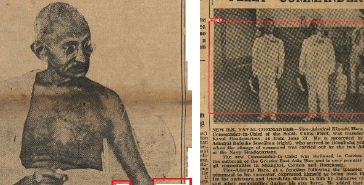
This paper presents the methodologies to extract the headline and illustrations from a historical newspaper for storytelling to support digital scholarship. It explored the ways in which new digital tools can facilitate the understanding of the newspaper content in the setting of time and space, "The Hongkong News" was selected from Hong Kong Early Tabloid Newspaper for the case study owing to its uniqueness in historical value towards the scholars. The proposed methodologies were evaluated in OCR (Optical Character Recognition) with scraping and Deep Learning Object Detection models. Two visualization products were developed to showcase the feasibility of our proposed methods to serve the storytelling purpose.
Museums are digitizing their collections of 3D objects. Video games provide the technology to interact with these objects, but the educational goals of a museum are often at odds with the creative forces in a traditional game for entertainment. Efforts to bridge this gap have either
settled on serious games with diminished entertainment value or have relied on historical fictions that blur the line between reality and fantasy. The Vessel project is a 3D game designed around puzzle mechanics that remains a game for entertainment while realizing the benefits of incorporating
digitized artifacts from a museum. We explore how the critical thinking present in solving puzzles can still encourage engagement of the story the artifacts have to tell without creating an historical fiction. Preliminary results show a preference for our in-game digital interaction over a
traditional gallery and a desire to learn more about the artifacts after playing.