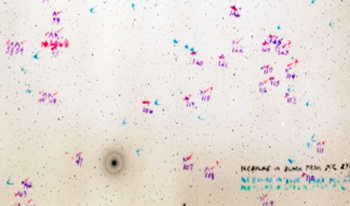
The Harvard Plate Stacks (HPS) Astronomical Photographic Glass Plate Collection comprises over 600,000 glass plate negatives. To support collection preservation and improve accessibility, HPS integrated an advanced imaging system to digitize astronomical features in the emulsion layer, as well as annotations made by pioneering Women Astronomical Computers in the late 19th and early 20th centuries. HPS installed a multispectral imaging system to capture high-quality images of astronomical features dating back to the 1880s, along with their historical annotation, to advance both astronomical and cultural heritage research. This digitization of glass plate negatives builds upon 20 years of advanced imaging methodologies and technologies, using the latest equipment and workflows. This includes new post-processing techniques, data management, and workflows across discipline boundaries by a collaborative team.
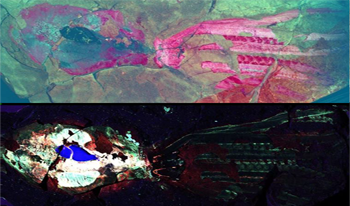
Over approximately the last 20 years, advances in scientific instrumentation have made many analytical techniques more readily accessible to the broader scientific community. This has empowered paleontologists, archeologists, conservators, scholars and preservation specialists to acquire new data types from multiple techniques, revealing important information about cultural and natural heritage objects, such as ancient documents and fossils. As such, the volume of data and metadata that can be acquired has dramatically increased, putting increased strain on researchers to process, analyze, interpret, archive and manage this data. This paper discusses the advances of synchrotron x-ray fluorescence (XRF) imaging and multispectral imaging in paleontological research to demonstrate the challenges of handling the data that can now be generated for such an object. It also addresses how facilities such as synchrotrons are generating big data, and how data from multiple techniques can be analyzed in a multimodal framework.
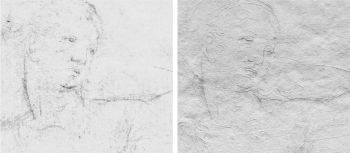
This study considers near-infrared raking reflectance imaging as a way to record incised lines, pricked holes, and other shallow stylus marks in drawings on paper. Such traces can clarify how a design was constructed, revised, or transferred between supports, but they are often difficult to interpret when drawing media visually compete with surface relief. Standard near-infrared reflectance imaging, typically recorded with symmetrical bilateral copy lighting, can reduce the visibility of some drawing media but does not strongly describe shallow deformations in the paper plane. Visible raking illumination emphasizes relief, yet visible media may remain dominant. Imaging experiments on a group of Renaissance drawings suggests that near-infrared, with a raking illumination geometry can help distinguish material deposits from impressed or incised marks, particularly where a stylus line diverges from adjacent media. The method also draws attention to a limitation in technical-imaging terminology: there is no standardized naming convention or prescribed order of terms for describing new imaging techniques or novel combinations of established methods. This paper proposes “near-infrared raking reflectance” as a description of the condition examined here and considers how recording illumination wavelength, geometry, and radiation mode in that order, may support more consistent documentation.
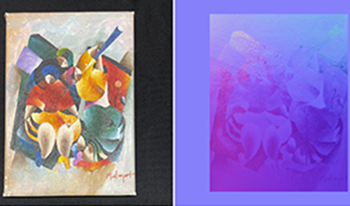
In this paper we introduce MISHA3D, a set of tools that enable 3D surface capture using the MISHA multispectral imaging system. MISHA3D uses a novel multispectral photometric stereo algorithm to estimate normal, height, and RGB albedo maps as part of the standard multispectral imaging workflow. The maps can be visualized and analyzed directly, or rendered as realistic, interactive digital surrogates using standard graphics APIs. Our hope is that these tools will significantly increase the usefulness of the MISHA system for librarians, curators, and scholars studying historical and cultural heritage artifacts.

Multispectral Imaging has become an indispensable tool for Cultural Heritage materials and objects analyzing, documenting, and visualizing. This study delves into applying this technique to an 18th-century illuminated manuscript at the Minas Gerais Public Archive, Brazil. Currently undergoing restoration intervention at The Federal University of Minas Gerais, the manuscript exhibits faded writing due to moisture, and the application of multispectral imaging (UV, Visible, and IR) with seven different wavelengths proves highly effective in recovering lost information. The light source was provided from LED and Halogen Lamp, and the result shows a very clear text on the manuscript after the digital processing by ImageJ and PCA. The Minas Gerais Public Archive, established in 1895, plays a vital role in safeguarding the state's documentary and historical heritage. It was the first-time multispectral imaging was applied to cultural objects in Minas Gerais.

Historic properties face challenges preserving and maintaining their physical heritage, as well as digitally sharing and accessing their history in a virtual environment. They are now utilizing new advanced imaging methods to research their cultural heritage artifacts. Recent advanced imaging in historic Civil War-era houses demonstrated the integration of imaging techniques and data to support conservation of these structures and research into their history and contents. New technical systems, including the latest narrowband multispectral imaging systems and higher resolution cameras, raise major challenges in not only the integration of new technologies, but also the ability to store, manage and access large amounts of data. Integration, preservation, access and collaboration with the image data from this program requires implementation of standardized digitization and data archiving practices.
We publish two carefully prepared and spectrally measured datasets of paint swatches. The main advantage of these datasets is that a diverse set of paint mixtures are manually prepared the way an artist may create them. The ratio of paints in each mixture is also published. The first set has 286 swatches made from 8 tubes of Old Holland oil paints in different combinations. The second set has 397 swatches made from 9 tubes of Schmincke watercolor paints. We provide exact details about the preparation of our swatches. We analyze the colorimetric and spectral properties of the two datasets in order to show the spread of the colorimetric gamut and the intrinsic, spectral dimensionality of the datasets. The dataset will be available on http://cam.mpi-inf.mpg.de/ and http://www.azadehasadi.com/.