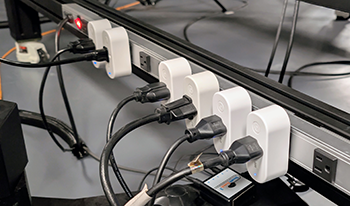
This study examines energy consumption in cultural heritage imaging systems and workflows, addressing a gap in sustainability research that has to date focused primarily on data storage infrastructure estimations. Using Home Assistant edge computing and Z-Wave smart plugs, seven distinct imaging systems were monitored over 203 hours, capturing 55,211 images, and rendering 2,448 objects. Results show an average energy requirement of 11.1 Wh per object, with an annual total of 747 kWh for digitization activities. Findings highlight opportunities to reduce energy demand and improve efficiency, such as automating continuous light shutoff and optimizing postprocessing routines that support institutional sustainability goals and provide a transparent, reproducible model for other labs and studios.

We present an end-to-end automated workflow that uses large-scale remote compute resources and an embedded GPU platform at the edge to enable AI/ML-accelerated real-time analysis of data collected for x-ray ptychography. Ptychography is a lensless method that is being used to image samples through a simultaneous numerical inversion of a large number of diffraction patterns from adjacent overlapping scan positions. This acquisition method can enable nanoscale imaging with x-rays and electrons, but this often requires very large experimental datasets and commensurately high turnaround times, which can limit experimental capabilities such as real-time experimental steering and low-latency monitoring. In this work, we introduce a software system that can automate ptychography data analysis tasks. We accelerate the data analysis pipeline by using a modified version of PtychoNN -- an ML-based approach to solve phase retrieval problem that shows two orders of magnitude speedup compared to traditional iterative methods. Further, our system coordinates and overlaps different data analysis tasks to minimize synchronization overhead between different stages of the workflow. We evaluate our workflow system with real-world experimental workloads from the 26ID beamline at Advanced Photon Source and ThetaGPU cluster at Argonne Leadership Computing Resources.