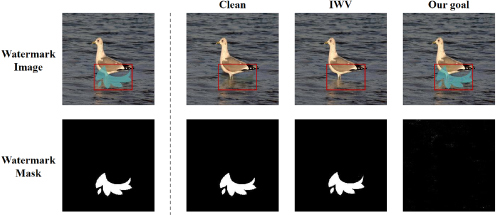
High-visibility watermarks with strong visual saliency are particularly vulnerable to removal by deep learning models. Existing adversarial-perturbation-based protection methods for visible watermarks often suffer from poor perturbation stability and significant image quality degradation in high-visibility scenarios. To address these challenges, the authors propose a cascaded coarse-to-fine framework that generates an adversarial perturbation High-visibility Watermark Vaccine (HWV), specifically aimed at protecting high-visibility watermarks. They establish a watermark-driven perturbation generation model and design cascaded loss functions for coarse and fine stages to guide the multi-phase search for a globally optimal adversarial solution. In the coarse stage, a composite loss function is constructed to achieve robust protection of high-visibility watermarks while in the fine stage, a perturbation minimization objective is introduced to mitigate the impact of perturbations on image quality. Moreover, the authors propose a novel gradient normalization equation combined with a dynamic momentum update strategy to adaptively optimize the perturbation step size, accelerating convergence toward the global optimum of the loss function. Experimental results on the CLWD dataset demonstrate that the proposed method effectively prevents removal attacks targeting high-visibility watermarked images. Furthermore, compared to conventional single-stage loss methods, this method significantly improves the image quality of perturbed watermark images, achieving a Peak Signal-to-Noise Ratio greater than 44 dB. This work provides a novel perspective for enhancing digital image copyright protection against deep-learning-based attacks.
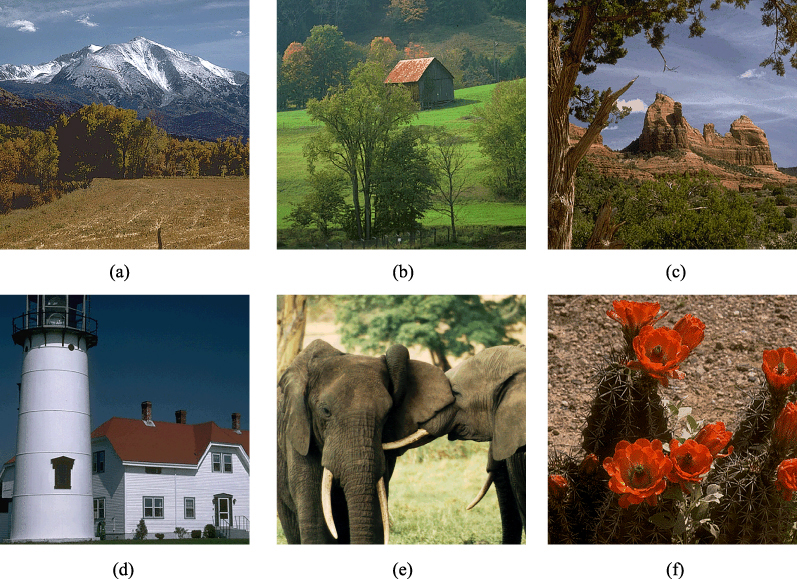
Embedding conspicuous digital visible watermarks on images inevitably compromises their original integrity. To address this challenge, we propose a reversible adaptive visible watermarking method that allows the watermark to be color adaptive, highly salient, and capable of traceless removal with authorization. This method relies on statistical analysis of the color information within the original image to determine the optimal stamp code for encoding the watermark pixels. Additionally, the use of the stamp code facilitates the reverse decoding of the watermark pixels, enabling traceless removal of the visible watermark. Experimental results show that the peak signal-to-noise ratio values of the carrier images reach approximately 50 after watermark removal. The normalized energy of watermark visibility is significantly improved compared to other reversible visible watermarking methods. These experiments highlight the method’s ability to realize adaptive addition and traceless removal of visible watermarks, solving the difficulties of balance between original image integrity and watermark clarity.