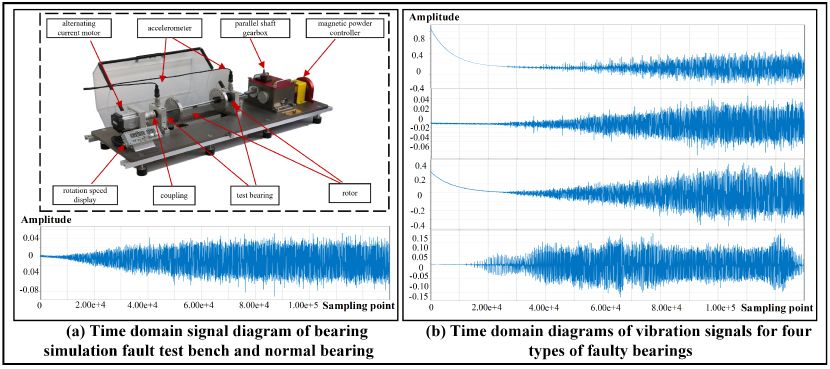
The authors propose a novel fault diagnosis method to address the challenges of complex fault feature extraction and low diagnostic efficiency caused by the intricate and variable frequency components of vibration signals and the mismatch between the sampling frequency and the actual bearing vibration under variable-speed conditions in printing equipment bearings. This method is based on improved Least Squares Support Vector Machines (LSSVMs) with Kernel Principal Component Analysis (KPCA) for dimension reduction and Deep Belief Networks (DBNs) for variable-speed feature mining. Time-domain feature values of the vibration signal were first extracted to construct a feature set, and the KPCA algorithm was applied for dimensionality reduction. Dimensionality reduction features were used as the input of the DBN to extract higher-order features and enhance the discriminant ability. Finally, the optimized features were classified and diagnosed using the LSSVM model, enabling the extraction of nonlinear complex features under variable-speed conditions and improving diagnostic efficiency. In addition, the lightweight design that combines KPCA dimensionality reduction, DBN deep feature extraction, and improved LSSVM classification effectively addresses the issue of low efficiency in feature extraction and diagnosis caused by the complex and variable vibration signals under variable-speed conditions. Experiments were conducted using bearing vibration data collected from a simulated test bench, covering five fault types. The bearing acceleration vibration signals were collected within 0–5 s and 0–10 s in the speed range of 0–1800 r/min. The proposed model achieved diagnostic accuracies of 98.33% and 98.8889% under these two conditions, respectively, verifying its effectiveness and superiority under complex operating conditions.