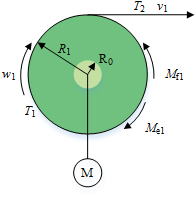
Maintaining stable tension is essential for ensuring the slitting quality of lithium battery separators. In particular, the precision of tension control in the unwinding system is critical to both product quality and process stability. This study proposes an optimized control strategy based on immune genetic algorithm-optimized active disturbance rejection control (IGA-ADRC) to address the tension regulation challenges in the unwinding system of lithium battery separator slitting machines. First, based on the operating mechanism of the unwinding system, a dynamic model was developed that incorporates time-varying parameters, nonlinear behavior, and strong coupling characteristics. Second, an active disturbance rejection controller was designed and optimized using an immune genetic algorithm, based on the tension dynamics of the unwinding system. Finally, the effectiveness of the proposed control strategy was validated through both simulations and experimental results. Simulation and experimental results demonstrate that the IGA-ADRC reduces tension deviation by 59.1% compared to proportional–integral–derivative control (from ±1.1 N to ±0.45 N) and by 25% compared to conventional ADRC (from ±0.6 N to ±0.45 N) while improving response speed and overshoot suppression. The proposed IGA-ADRC method achieves superior performance in terms of tension regulation accuracy, system robustness, and disturbance rejection capabilities.
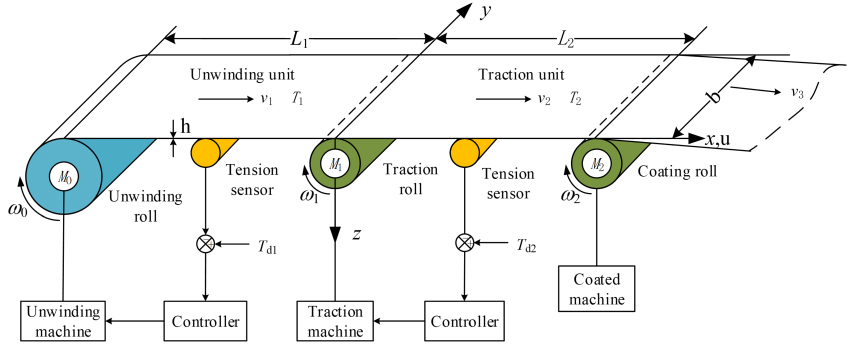
Ensuring smooth tension is imperative to maintaining the quality of lithium battery coating; particularly, the precision of tension control within the unwinding system is paramount to ensuring high-quality outcomes in subsequent processes and product fabrication. This paper proposes a fuzzy sliding mode variable structure control strategy based on the tension control of the unwinding system to meet the stability requirements of tension in the lithium battery coater’s unwinding system. First, we establish a nonlinear time-varying dynamic model of the unwinding system by elucidating the operational principles of the lithium battery coater unwinding system. Second, leveraging the tension model of the unwinding system, we devise a fuzzy sliding mode variable structure controller specifically tailored for tension control, subsequently conducting a stability analysis of the system. Finally, the effectiveness of the proposed fuzzy sliding mode variable structure controller is validated through simulation tests. Experimental results demonstrate that the devised fuzzy sliding mode variable structure controller exhibits superior robustness compared to both traditional proportional–integral–derivative control and sliding mode variable structure control.