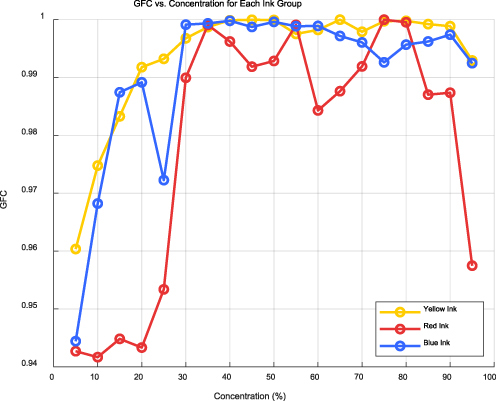
Accurate spot color matching is critical to printing applications, yet constructing an efficient ink base database remains a challenge due to the labor-intensive preparation of ink ladder samples. This study proposes a two-step optimization method to enhance the efficiency and accuracy of spot color prediction using the single-constant Kubelka–Munk (KM) model. The first step employs spectral similarity screening via the Goodness-of-Fit Coefficient to select samples with consistent spectral behavior. The second step optimizes for K/S linearity, identifying concentrations (35% and 40%) that best align with the KM model’s linearity assumption. Five target spot colors, created by mixing yellow, red, and blue base inks, were used to evaluate the method. The K/S values derived from three sample sets—all ladder samples, one-step optimized samples, and two-step optimized samples—were used to predict spectral reflectance and CIE Lab values, with color differences (ΔE) calculated against measured values. The two-step optimized samples achieved the lowest average ΔE value of 3.08 compared to 7.38 for all samples and 4.59 for one-step optimized samples, demonstrating superior accuracy. By reducing the required samples from 19 to 2 per ink, the method significantly enhances efficiency without compromising precision. These findings highlight the importance of spectral consistency and K/S linearity for reliable color matching and offer a practical solution for industrial applications such as packaging and branding.