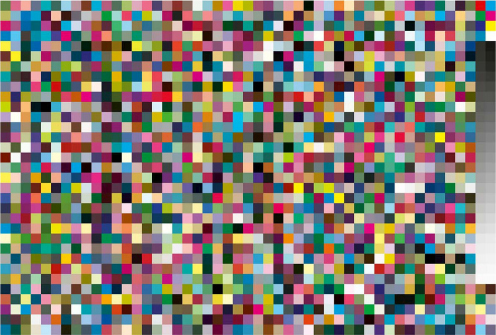
Accurate spectral prediction of CMYK printed images is critical for ensuring color reproduction fidelity in modern printing processes. Traditional physical models, such as the Murray-Davies and Yule–Nielsen models, have constraints in capturing the complexity of ink interactions and the contribution of black ink, resulting in decreased spectral prediction accuracy. To address these challenges, a novel multi-output weighted support vector regression (MO-WSVR) model for multispectral reconstruction of CMYK printed images is proposed. By modeling multiple spectral bands cumulatively, MO-WSVR is capable of predicting a range of spectral points simultaneously. Furthermore, the model incorporates a dynamic weighting mechanism that assigns greater weights to spectral points with higher prediction errors, enabling the model to better accommodate the inherent characteristics of CMYK printed images. Experimental results demonstrated that the MO-WSVR model significantly outperformed traditional physical models and existing data-driven prediction methods, based on root mean square error (RMSE) and colorimetric accuracy (CIEDE2000).

Characterization data for printers is obtained by printing a test chart on the intended production substrate. In practice it is common for a different substrate to that used to obtain the characterization data to be used in proofing and in production, and this requires either reprinting and re-measuring the test chart or estimating new characterization data. Methods to do this exist for colorimetric characterization data, but with the increasing use of spectral data in the workflow, there is a need for a method that can be applied to spectral. reflectances. This paper proposes two different methods of adjusting printer spectral color characterization data for a change in substrates. In the first part, a Spectral Correction Technique was applied to spectral reflectance data obtained from different printers to predict a spectral color characterization data for an additional substrate. In the second part, the reference printing condition was used to adjust spectral color characterization data. The results were evaluated, and it was found that a good prediction is achieved with the use of machine learning.