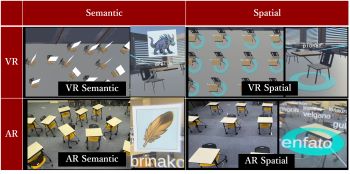
As extended reality (XR) technologies in education—particularly Augmented Reality (AR) and Virtual Reality (VR)—advance rapidly, there is a growing need to understand how these platforms influence cognitive learning processes. Vocabulary acquisition, a core aspect of second-language learning, relies heavily on memory strategies. However, it remains unclear how platform-specific features, such as contextual anchoring in AR or spatial immersion in VR, interact with different strategies to affect learning outcomes. This study examines how two key memory strategies, semantic association and spatial positioning, perform in AR and VR environments during second-language vocabulary learning. Specifically, it investigates whether a strategy–platform compatibility exists, in which certain strategies may be more effective depending on the platform’s cognitive affordances.

Successful navigation requires spatial cognition abilities, primarily the development of an accurate and flexible mental, or cognitive, map of the navigational space and of the route trajectory required to travel to the target location. To train the spatial cognition abilities and spatial memory underlying successful navigation, we translated the power of the Likova Cognitive-Kinesthetic Rehabilitation Training, initially developed for the manual domain of operation, to the domain of navigation. In the tasks requiring the mentally-performed navigational decision planning (planning the shortest or the reversed shortest path between newly-specified locations on a just memorized tactile map) and memory-guided motor execution of these decisions (accurate drawing the respective planned paths), the most significant brain activation increase was found in the two medial posterior cortical regions (DLPFC, insula), in contrast to a very little change in the lateral anterior regions (occipital V1-V4, the retrosplenial/precuneus) for most of these tasks. By extending our previous findings from the manual to the navigation domain, these results demonstrate the power of a multidisciplinary approach incorporating art, behavioral and neuroscience methodologies to drive much-needed plasticity in the adult brain.