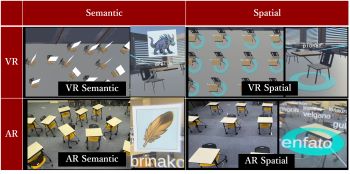
As extended reality (XR) technologies in education—particularly Augmented Reality (AR) and Virtual Reality (VR)—advance rapidly, there is a growing need to understand how these platforms influence cognitive learning processes. Vocabulary acquisition, a core aspect of second-language learning, relies heavily on memory strategies. However, it remains unclear how platform-specific features, such as contextual anchoring in AR or spatial immersion in VR, interact with different strategies to affect learning outcomes. This study examines how two key memory strategies, semantic association and spatial positioning, perform in AR and VR environments during second-language vocabulary learning. Specifically, it investigates whether a strategy–platform compatibility exists, in which certain strategies may be more effective depending on the platform’s cognitive affordances.