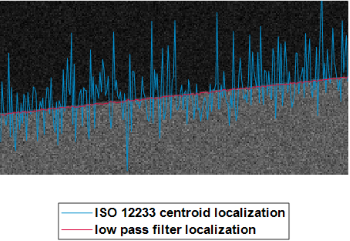
Edge localization plays a critical role in ISO 12233 e-SFR analysis, influencing both sharpness results and downstream information capacity metrics. This paper evaluates the accuracy of the standard centroid, low-pass filter, and matched filter-based localization methods across an ensemble of simulated slanted edge ROIs. Localization errors are quantified by benchmarking each method against ground truth, and their propagation to e-SFR results and information capacity is measured. Findings show that centroid fitting introduces angular bias under noise, leading to a degraded effective response, while low-pass filtering and matched filtering both maintain robust accuracy. These results highlight an under-characterized source of error in standards-based image quality analysis and provide a foundation for improved methods. The results support a closer alignment between edge analysis, information-theoretic models, and emerging metrics such as those proposed in ISO/WD 23654 (Digital Imaging — Information Metrics).
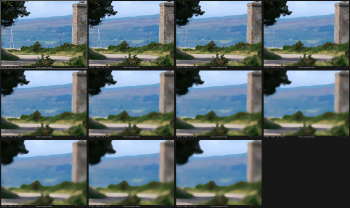
In order to determine the lowest light level at which a digital camera can still deliver acceptable images, acceptance thresholds must be established for all related image quality factors. ISO 19093 describes these factors and how they can be measured. However, the acceptance thresholds may depend on the application for which the images were captured, as well as on people's individual tolerance for degradation in the different image quality factors. To generate a standard set of tolerance levels for photographic applications, a psychophysical experiment was performed, as described in this paper. First, a group of 23 image quality experts participated, followed by 16 people with no specific experience in imaging. The same experiment was repeated for the specific application of security cameras. The set of images, as well as the questions asked of the participants, were adapted to the use case. For the security application, 27 participants with a background in security camera imaging took part.

The Modulation Transfer Function (MTF) and the Noise Power Spectrum (NPS) characterize imaging system sharpness/resolution and noise, respectively. Both measures are based on linear system theory. However, they are applied routinely to scene-dependent systems applying non-linear, content-aware image signal processing. For such systems, MTFs/NPSs are derived inaccurately from traditional test charts containing edges, sinusoids, noise or uniform luminance signals, which are unrepresentative of natural scene signals. The dead leaves test chart delivers improved measurements from scene-dependent systems but still has its limitations. In this article, the authors validate novel scene-and-process-dependent MTF (SPD-MTF) and NPS (SPD-NPS) measures that characterize (i) system performance concerning one scene, (ii) average real-world performance concerning many scenes or (iii) the level of system scene dependency. The authors also derive novel SPD-NPS and SPD-MTF measures using the dead leaves chart. They demonstrate that the proposed measures are robust and preferable for scene-dependent systems to current measures.