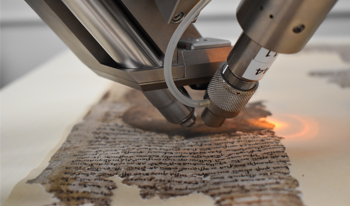
As institutions face reduced staffing with the same number of requests for research and services, being able to optimize the collection of data and workflows becomes critical. Many workflows in analyzing cultural heritage objects become standard practice, but we often accept this as “the new process” without fully documenting and reviewing the effectiveness. Scientists in the Preservation Research and Testing Division (PRTD) have developed efficient workflows that utilize non-invasive optical imaging and spectroscopies and have added another component that greatly improves accuracy to the activities, fully characterized reference samples. Within PRTD, the Center for Heritage Analytical Reference Materials (CHARM), is a collection of heritage scientific non-collection samples that have been characterized by a range of imaging modalities and spectroscopies, so that identification of inks, pigments, various substrates and additives can be readily identified from the reference data that has been captured. Working together in teams, pre-identifying regions of interest (ROIs) and having pre-characterized samples available to confirm composition of heritage materials being analyzed has led to a productive outcome.