
Accurate spectral prediction of CMYK printed images is critical for ensuring color reproduction fidelity in modern printing processes. Traditional physical models, such as the Murray-Davies and Yule–Nielsen models, have constraints in capturing the complexity of ink interactions and the contribution of black ink, resulting in decreased spectral prediction accuracy. To address these challenges, a novel multi-output weighted support vector regression (MO-WSVR) model for multispectral reconstruction of CMYK printed images is proposed. By modeling multiple spectral bands cumulatively, MO-WSVR is capable of predicting a range of spectral points simultaneously. Furthermore, the model incorporates a dynamic weighting mechanism that assigns greater weights to spectral points with higher prediction errors, enabling the model to better accommodate the inherent characteristics of CMYK printed images. Experimental results demonstrated that the MO-WSVR model significantly outperformed traditional physical models and existing data-driven prediction methods, based on root mean square error (RMSE) and colorimetric accuracy (CIEDE2000).
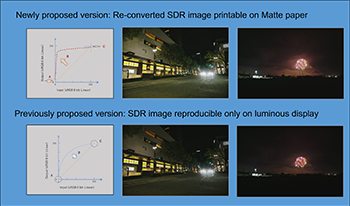
Printing display images normally proceeds well provided they comply with the SDR gamut supported by color management systems (CMS), like ICM used in Windows OS. Twilight vision, unfortunately, complicates this process, as it is quite difficult to convert images captured by UHDR systems given that their contrast ratios (CR) sometime exceeded 10^6:1 or so; SDR images have CR values of approx. 100:1. A typical example is the reproduction of lunar texture. Quite recently, we resolved this problem by employing just global tone mapping (GTM). Even with the use of GTM, emissive displays like LCD, not projection displays or printed matter, are strongly recommended to prevent image quality degradation. This study addresses the reasons why CMS fail to handle twilight vision material well and proposes enhanced GTM for printing emissive display images. The main point is the difference between the perception responses demonstrated in daytime and in twilight, even after the UHDR material is converted into SDR images. In other words, the key idea is to focus on the underutilized top and bottom margins of the reproduced SDR images. From another viewpoint, the most important result is the acquisition of super sensitivity. Our proposal enables high sensitivity even with the same sensor (increase is approx. 10 to 30 times).