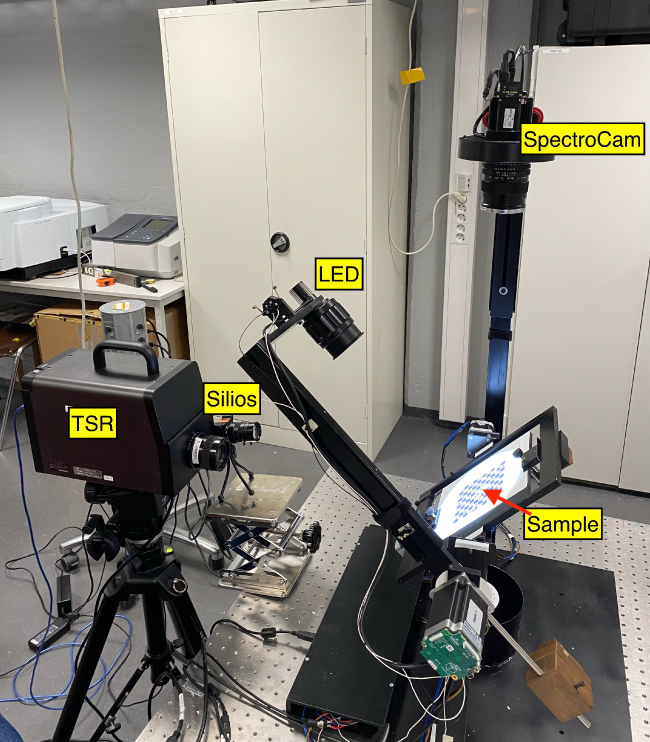
This paper presents a comprehensive experimental evaluation of spectral reconstruction methods in multispectral imaging systems, focusing on two multispectral camera technologies with differing spectral characteristics: spectral filter array and filter wheel. These systems were assessed under a controlled LED-based illumination setup. A range of reconstruction methods, encompassing both model-based and training-based approaches, were analyzed in their baseline forms as well as in adaptive configurations, which select optimal local training subsets based on spectral reflectance or camera response similarity. Experiments were conducted using a custom-built imaging setup and two well-characterized spectral reflectance datasets: the standard Munsell and the Munsell Student Color sets.
Results demonstrate that training-based methods significantly outperform model-based methods in both spectral and colorimetric accuracy. Adaptive dataset selection further enhances performance in many cases, particularly for the SpectroCam filter wheel camera. The influence of illumination on reconstruction accuracy is also examined, revealing that model-based methods are especially sensitive to the spectral power distribution of the light source. These findings offer practical and technical guidance for the design and calibration of multispectral imaging systems aimed at achieving high-accuracy spectral recovery.