
Culture can play a significant role in evaluating image quality. Therefore, this work considered one of the least studied cultural regions of observers, examining the impact of Central Asian culture on image quality evaluation. More specifically, it investigated how they evaluate the quality of contrast-enhanced images. It was found that observer evaluations vary and can be divided into groups. These groups may have their individual preferences for the quality of contrast-enhanced images. Therefore, the personalization factor should be incorporated into the quality evaluation of (contrast-) enhanced images. Furthermore, the results were compared with another population and differences were found in the overall outcomes of the two observer groups. The variations observed could be due to cultural differences. In addition, this study introduced the Central Asian Contrast-Enhanced Image Quality Dataset (CACEIQD). A variety of image quality metrics, including deep learning techniques, were tested on the dataset. The results indicate that the dataset is challenging and highlight an area for metric improvement. This dataset can be helpful for future research in the field of enhanced image quality evaluation.
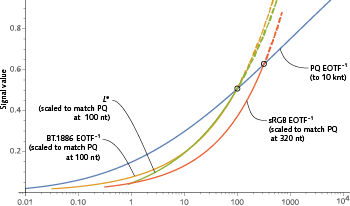
High dynamic range (HDR) technology enables a much wider range of luminances – both relative and absolute – than standard dynamic range (SDR). HDR extends black to lower levels, and white to higher levels, than SDR. HDR enables higher absolute luminance at the display to be used to portray specular highlights and direct light sources, a capability that was not available in SDR. In addition, HDR programming is mastered with wider color gamut, usually DCI P3, wider than the BT.1886 (“BT.709”) gamut of SDR. The capabilities of HDR strain the usual SDR methods of specifying color range. New methods are needed. A proposal has been made to use CIE LAB to quantify HDR gamut. We argue that CIE L* is only appropriate for applications having contrast range not exceeding 100:1, so CIELAB is not appropriate for HDR. In practice, L* cannot accurately represent lightness that significantly exceeds diffuse white – that is, L* cannot reasonably represent specular reflections and direct light sources. In brief: L* is inappropriate for HDR. We suggest using metrics based upon ST 2084/BT.2100 PQ and its associated color encoding, IC<sub>T</sub>C<sub>P</sub>.