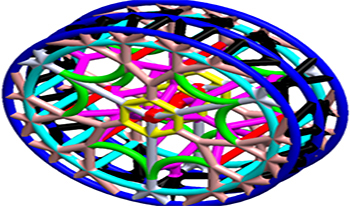
This study develops a lightweight bionic energy-absorbing structure (loofah sponge bionic structure [LSBS]), inspired by the highly porous loofah sponge, suitable for additive manufacturing. The loofah sponge is partitioned into four functional regions and characterized by regional compression tests, based on which eleven main characteristic structures are extracted and integrated into a parametric 3D model. Finite element simulations in ANSYS Workbench 15.0, combined with structural specific strength and structural specific stiffness indices, are used to evaluate lightweight performance under static and compressive loading. The LSBS specimens are fabricated by DLP (UV-curable resin [UVCR]) and FDM (PLA) and tested in quasi-static compression. The PLA-LSBS exhibits markedly higher energy absorption than UVCR-LSBS, attaining 4.39 J⋅g−1 mass-specific energy absorption and 5.48 J⋅cm−3 volume-specific energy absorption, with a 135.10% higher peak load and only 0.83 g extra mass. These results verify the effectiveness of the extracted loofah-inspired features and demonstrate a feasible pathway for designing lightweight, high-energy-absorbing structures via 3D printing.
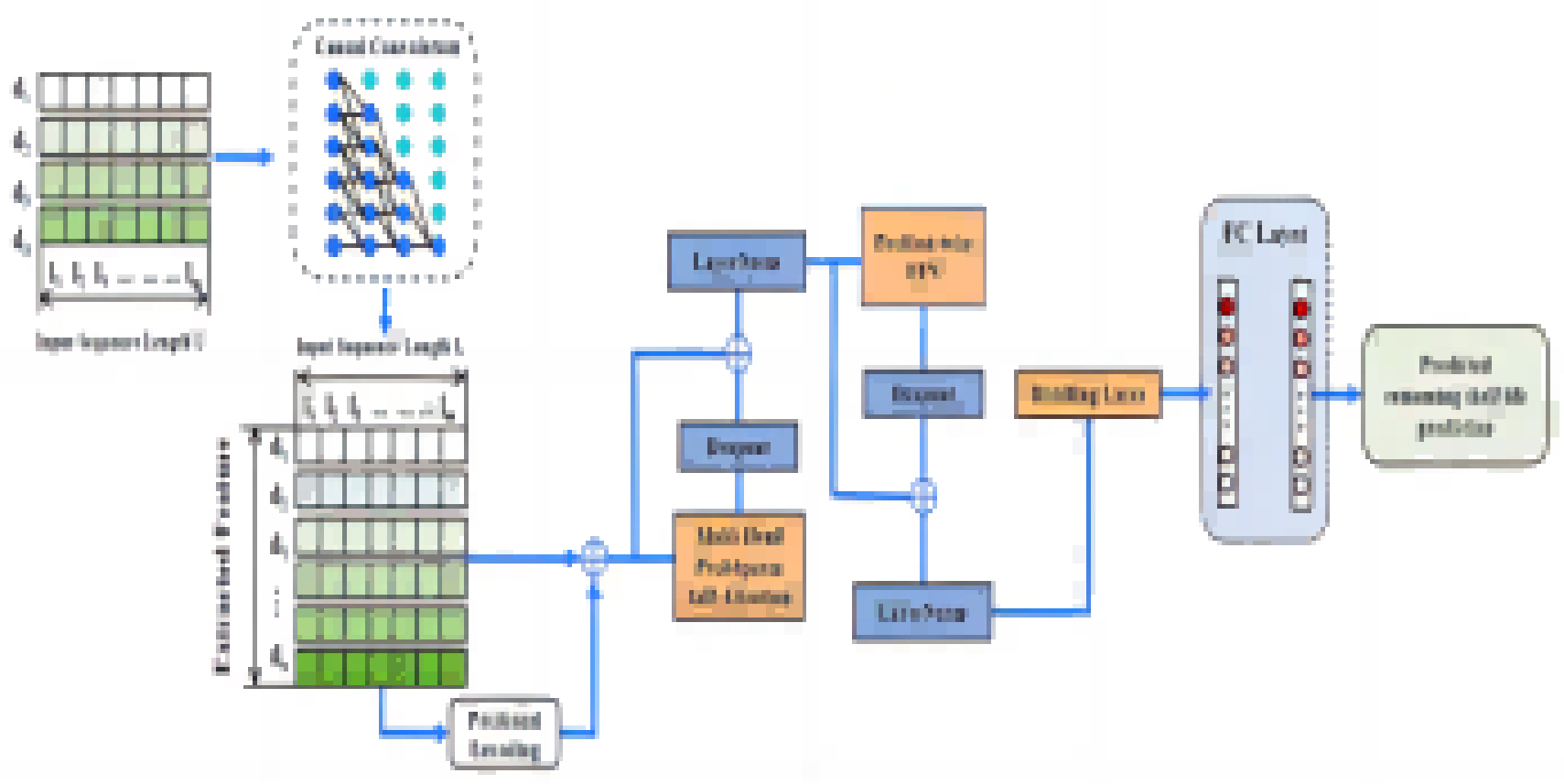
Accurately predicting the remaining shelf life can effectively reduce the risk of spoilage during the storage process of agricultural products. The quality of agricultural products can be indirectly indicated by changes in environmental parameters. To better explore the intrinsic relationship between key environmental parameters during banana storage and their remaining shelf life, this paper proposes a novel causal convolution lightweight Transformer network. This model utilizes causal convolution operations to mine the temporal features of sensor data and applies positional encoding to the input signals. It employs a Transformer encoder to extract and fuse features while also utilizing a probabilistic sparse self-attention mechanism instead of the conventional self-attention mechanism. Moreover, a distillation operation is introduced, which effectively reduces the number of trainable parameters in the Transformer-based model and shortens the training time. Compared to traditional machine learning algorithms (BP, SVM) and conventional time series data mining algorithms (LSTM, RNN), the proposed prediction method achieves a mean squared error of 0.0221, a root mean squared error of 0.1486, a mean absolute error of 0.1101, and a maximum prediction error of 0.2221 days, allowing for more accurate and efficient predictions of bananas’ remaining shelf life.