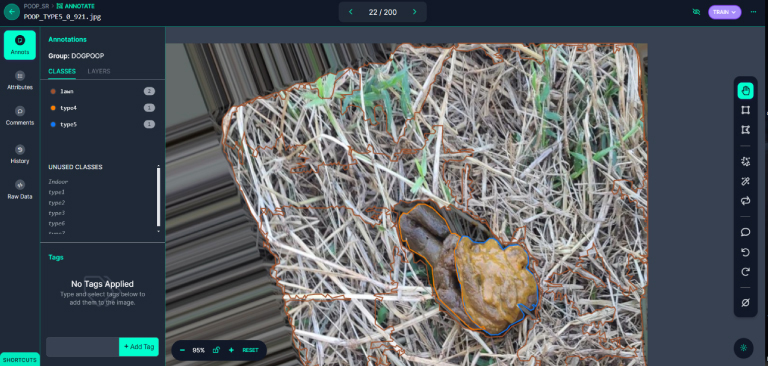
As pets now outnumber newborns in households, the demand for pet medical care and attention has surged. This has led to a significant burden for pet owners. To address this, our experiment utilizes image recognition technology to preliminarily assess the health condition of dogs, providing a rapid and economical health assessment method. By collaboration, we collected 2613 stool photos, which were enhanced to a total of 6079 images and analyzed using LabVIEW and the YOLOv8 segmentation model. The model performed excellently, achieving a precision of 86.805%, a recall rate of 74.672%, and an mAP50 of 83.354%. This proves its high recognition rate in determining the condition of dog stools. With the advancement of technology and the proliferation of mobile devices, the aim of this experiment is to develop an application that allows pet owners to assess their pets’ health anytime and manage it more conveniently. Additionally, the experiment aims to expand the database through cloud computing, optimize the model, and establish a global pet health interactive community. These developments not only propel innovation in the field of pet medical care but also provide practical health management tools for pet families, potentially offering substantial help to more pet owners in the future.

For person re-identification (re-ID), nearly all person re-ID algorithms use public person re-ID datasets, where these datasets all consist of predefined image crops containing a single person. Unfortunately, these image crops are not optimal for video analysis, so that the person detection becomes suboptimal and person re-ID obtains a lower performance score. In this work, several techniques are presented that customize the person images of a popular public person re-ID dataset. These techniques consist of customization algorithms based on postprocessing the person-detection bounding boxes using the original frames, resulting in several customized datasets to better facilitate person re-identification. We have evaluated five different ways for customization, based on widening the image crops, various aspect ratios and resolutions, and person instance segmentation. We have obtained a significant increase in performance with widened image crops, yielding a convincing performance increase of nearly 3% in the resulting Rank-1 score. Furthermore, when the applied random-cropping process is further optimized to this customization technique, an increase of even more than 4% is obtained. Both performance gains are a strong indication that any future person re-ID system may benefit from customizations based on the original video frames or from specializing the person detector.