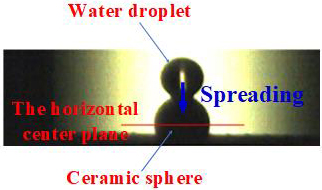
The dynamic spreading characteristics of purified water and anhydrous ethanol droplets impacting the surface of ceramic spheres were investigated experimentally using a high-speed digital camera operating at 3,000 frames per second. The spreading height factor of the droplets was quantitatively calculated by adding gratings behind the images in AutoCAD. The results are as follows: the droplets generated by the drip flow method are stable in size, are regular in shape, have easily controllable speed, and are ideal for spreading experiments; purified water droplets exhibit pronounced oscillations after impacting the smooth surface of ceramic spheres, whereas anhydrous ethanol droplets rapidly reach a stable state after a single spreading. This behavior difference is attributed to the lower surface tension of anhydrous ethanol droplets compared to purified water, resulting in a weaker contraction force. The time for purified water droplets to reach their minimum spreading height increases with increase in impact velocity. The minimum spreading height decreases to a constant value with increase in the impact velocity of droplets. In the retraction stage, the spreading height factor of the purified water droplet first decreases and then increases with increase in the impact velocity of droplets. The minimum spreading height of anhydrous ethanol droplets impacting the smooth surface of ceramic spheres decreases with increase in droplet impact velocity. However, it no longer decreases with increase in impact velocity when the spreading height factor reaches 0.06. As the impact velocity of purified water droplets increases, the droplets spread further across the horizontal center plane of the sphere and continue downward without retraction. Its critical impact velocity decreases with increase in diameter ratio between the droplet and the ceramic sphere.
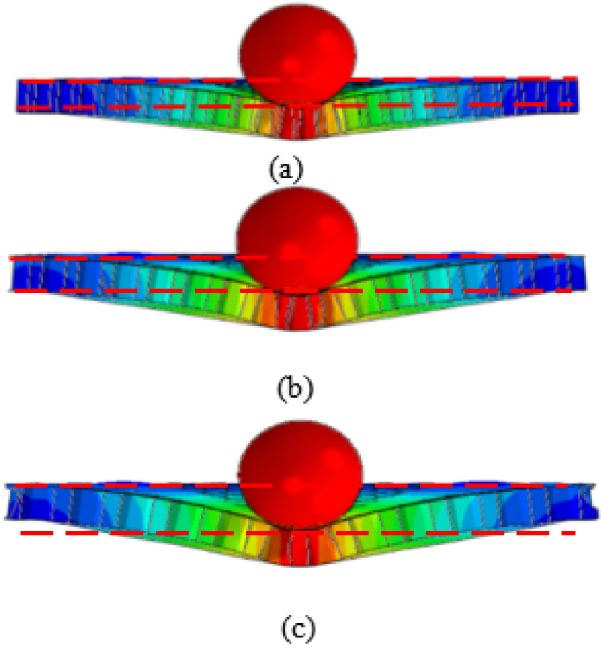
As a porous sandwich plate system, the honeycomb paperboard is widely used in cushioning packaging of products due to its energy-absorbing properties. The drop impact on a honeycomb paperboard with cell sizes of 4 mm, 6 mm, and 8 mm was simulated and experimented to investigate the paperboard’s energy absorption and deformation modes. The peak impact force of the impactor with velocity 5.47 m s−1, the dent depth of the honeycomb paperboard, and the absorbed energy were obtained. The peak forces corresponding to the core layer cell sizes of 4 mm, 6 mm, and 8 mm were 141.2 N, 108.7 N, and 97.7 N, and the absorbed energy values were 76%, 83%, and 84%, respectively. The model of honeycomb paperboard under drop impact was established. The plastic deformation and force distribution showed good agreement with experimental results, which verified the accuracy of the model. The results are expected to provide a reference for the lightweight structure and protective design of the honeycomb paperboard.