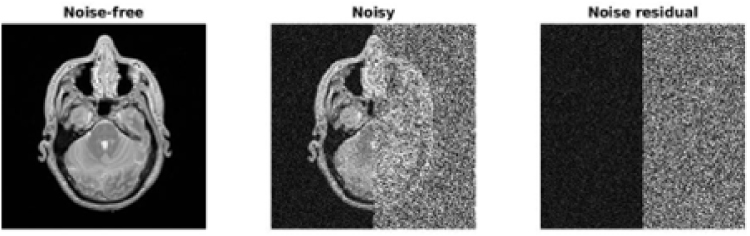
In this paper, the authors propose a new method for the denoising of magnetic resonance imaging (MRI) corrupted by noise with spatially varying noise levels. The dual-tree complex wavelet transform (DTCWT) is selected instead of the scalar wavelet transform because the DTCWT has the shift-invariant property, which is very useful in image denoising. The noise levels are estimated locally from MRI images by the DTCWT, which can be computed as a 2D matrix from the finest high-frequency subband. The k-means is used to segment the image into different regions with similar noise levels, and then denoising is performed for every region with block matching and 3D filtering (BM3D). The denoised regions are combined together and the boundary is smoothed so that better denoised image can be obtained. Experiments demonstrate that this new method outperforms several existing image denoising methods such as wiener2 filter, wavelet denoising, bivariate wavelet shrinkage, SURELET, non-local means, and BM3D even if the noise levels vary spatially.
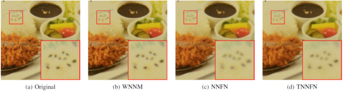
Multichannel methods have attracted much attention in color image denoising. These are image denoising methods that combine the low-rankness of a matrix with the nonlocal self-similarity of a natural image. The methods apply to color images with noise of different intensities in each color channel. Denoising methods based on the low-rankness of tensors, and extensions of matrices, have also attracted attention in recent years. Many tensor-based methods have been proposed as extensions of matrix-based methods and have achieved higher denoising performance than matrix-based methods. Tensor-based methods perform denoising using an approximate function of the tensor rank. However, unlike multichannel methods, tensor-based methods do not assume different noise intensities for each channel. On the other hand, the tensor nuclear norm minus Frobenius norm (TNNFN) has been proposed in the domain of traffic data completion. The TNNFN is one of the tensor rank approximation functions and is known to have high performance in traffic data completion, but it has not been applied to image restoration. In this paper, we propose MC-TNNFN as a tensor-based multichannel method. It is a TNNFN-based multichannel method that uses TNNFN to remove noise from a tensor constructed from similar patches and then estimates the original image. Experimental results using natural images show that the proposed method outperforms existing methods objectively and subjectively.

The paper considers a problem of automatic analysis and noise suppression in dental X-Ray images, e.g., in images acquired by dental Morita system. Such images contain spatially correlated noise with unknown spectrum and with standard deviation that varies for different image regions. In the paper, we propose two deep convolutional neural networks. The first network estimates the spectrum and level of noise for each pixel of a noisy image, predicting maps of noise standard deviation for three image scales. The second network uses the maps as inputs to suppress noise in the image. It is shown, using modelled and real-life images, that the proposed networks provide PSNR for dental X-Ray images by 2.7 dB better than other modern denoising methods.