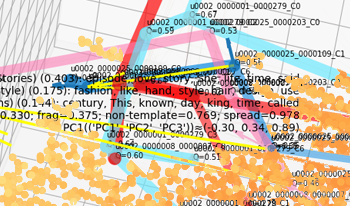
Digitized special collections archives are discoverable largely through full-text search via indexing and categorical methods of librarianship expressed in finding aid arrangement, which privileges established terms and inherited description. By contrast, this work is a computational arrangement method that compares clustered sentence embedding structures to promote discovery when lexicon and semantic terms differ. We explore modeling texts as a graph of directed semantic displacements in a vector embedding space and conceptualize sections of these graphs as an extrinsically comparable morphism. We evaluate these graph structures as a semiotic medium by comparing alignments across graphs from various types of OCR texts, and language-like noise datasets. Findings suggest potential interoperative value in morphism aligned text. Work sees potential applications for interdisciplinary discovery and unsupervised archival arrangement.