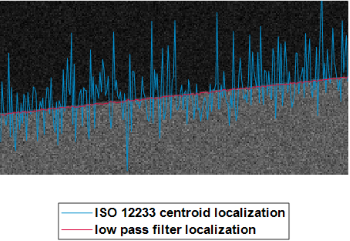
Edge localization plays a critical role in ISO 12233 e-SFR analysis, influencing both sharpness results and downstream information capacity metrics. This paper evaluates the accuracy of the standard centroid, low-pass filter, and matched filter-based localization methods across an ensemble of simulated slanted edge ROIs. Localization errors are quantified by benchmarking each method against ground truth, and their propagation to e-SFR results and information capacity is measured. Findings show that centroid fitting introduces angular bias under noise, leading to a degraded effective response, while low-pass filtering and matched filtering both maintain robust accuracy. These results highlight an under-characterized source of error in standards-based image quality analysis and provide a foundation for improved methods. The results support a closer alignment between edge analysis, information-theoretic models, and emerging metrics such as those proposed in ISO/WD 23654 (Digital Imaging — Information Metrics).