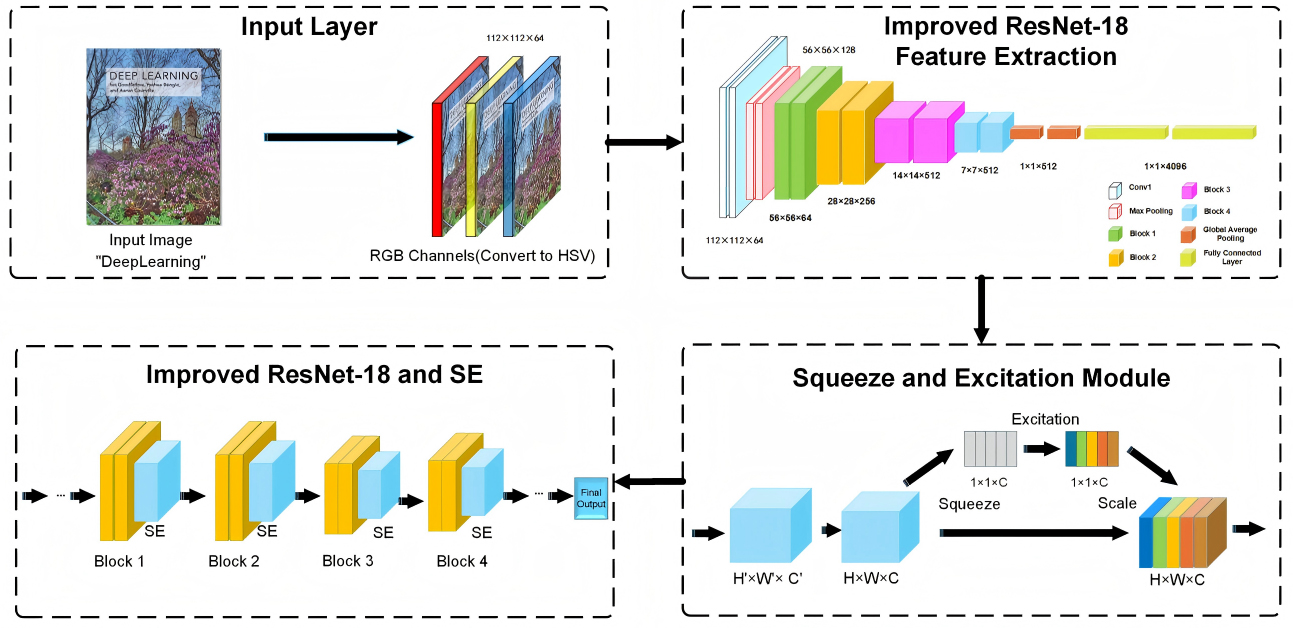
This paper proposes a deep-learning-based method for detecting color defects in book covers, achieved by integrating an improved Residual Network-18 (ResNet-18) architecture with the squeeze-and-excitation (SE) module for feature optimization. Addressing the color quality monitoring needs in industrial scenarios, a three-stage optimization strategy is adopted: at the data level, diversified samples are generated by combining the Hue, Saturation, and Value color space perturbation with mixed data augmentation techniques, and the synthetic minority oversampling technique is applied to solve class imbalance; at the model level, the ResNet-18 fully connected layers are reconstructed, and the SE channel attention mechanism is embedded to enhance feature representation; at the training level, a binary cross-entropy loss function is designed alongside dynamic learning rate scheduling, and K-fold cross-validation is utilized to ensure model stability. Experimental results show that the proposed method achieves a detection accuracy of 99.82% on the test set (RMSE = 0.1490), with an image processing time of only 57.66 ms per image. Its classification performance, robustness, and computational efficiency significantly outperform traditional pixel analysis methods, support vector machines, and backpropagation neural networks, providing an efficient solution for intelligent printing quality detection.
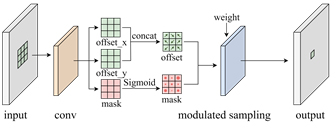
Steel surface defect detection is essential for ensuring product quality and reducing costs in industrial manufacturing. Current methods have achieved promising performance, but challenges remain due to the diversity and complexity of defect types, sizes, and geometries. To address these challenges, this paper proposes MDF-YOLO, a lightweight and high-performance detection framework specifically designed for steel surface defect detection. To better handle complex defect geometries and scale variations, a Modulated Deformable Convolution Network (MDCNet) is integrated into the backbone to enable adaptive feature extraction. In addition, a Dynamic Coordination Mechanism (DyCM) is incorporated into the feature fusion neck between the backbone and detection head to strengthen multiscale feature fusion and spatial sensitivity. Furthermore, a Focaler-GIoU loss function is adopted to improve localization accuracy and reduce sample imbalance during bounding box regression. Experiments on the NEU-DET dataset demonstrate consistent performance gains. Compared with the baseline YOLOv8n, the proposed method achieves improvements of 3.9% in mAP@0.5, 3.2% in F1 score, 0.6% in recall, and 5.7% in precision. Overall, the proposed approach provides a robust, efficient, and deployment-friendly solution. It improves the performance of industrial surface defect detection systems.
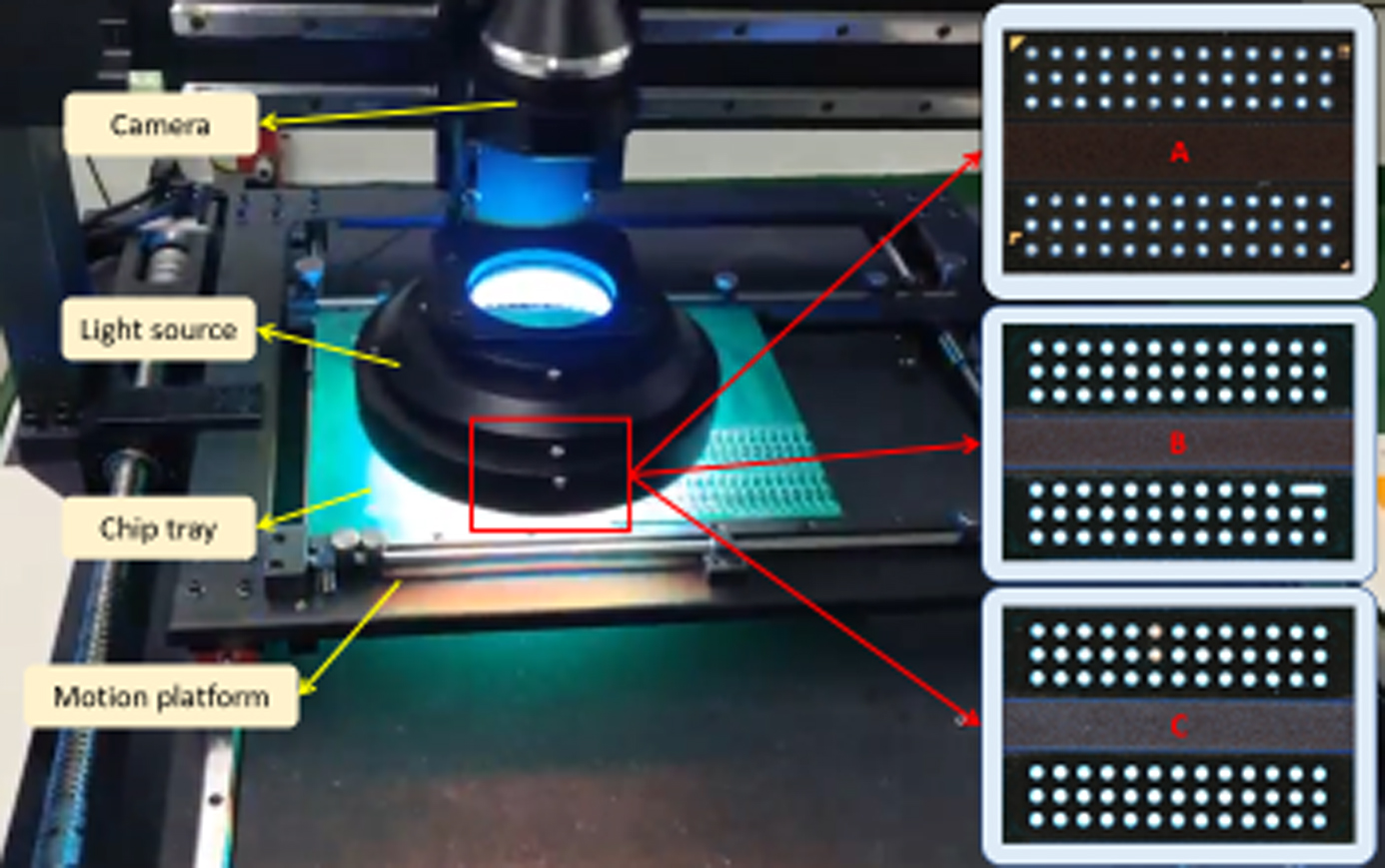
In response to the current challenges in the detection of solder ball defects in ball grid array (BGA) packaged chips, which include slow detection speed, low efficiency, and poor accuracy, our research has addressed these issues. We have designed an algorithm for detecting solder ball defects in BGA-packaged chips by leveraging the specific characteristics of these defects and harnessing the advantages of deep learning. Building upon the YOLOv8 network model, we have made adaptive improvements to enhance the algorithm. First, we have introduced an adaptive weighted downsampling method to boost detection accuracy and make the model more lightweight. Second, to improve the extraction of image features, we have proposed an efficient multi-scale convolution method. Finally, to enhance convergence speed and regression accuracy, we have replaced the traditional Complete Intersection over Union loss function with Minimum Points Distance Intersection over Union (MPDIoU). Through a series of controlled experiments, our enhanced model has shown significant improvements when compared to the original network. Specifically, we have achieved a 1.7% increase in mean average precision, a 1.5% boost in precision, a 0.9% increase in recall, a reduction of 4.3 M parameters, and a decrease of 0.4 G floating-point operations per second. In comparative experiments, our algorithm has demonstrated superior overall performance when compared to other networks, thereby effectively achieving the goal of solder ball defect detection.