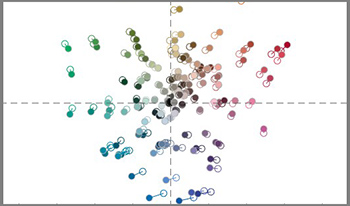
The application of color-difference measures to evaluate the accuracy of image capture for collections is common practice. For example, the FADGI imaging guidelines express acceptable tolerances in terms of the ΔE00 value. The color-accuracy evaluation assesses the extent to which the delivered image represents the desired color encoding of the object or scene. This is usually done with standard test targets, and the color encoding will depend on the selected color image space. Since different image color spaces are defined with different illuminants, it is common practice to transform the color coordinates between those for different illuminants. We can think of these transforms as approximations of complete recalculations that would be based on spectral reflectance data and visual color-matching functions. We address one such common transform in the context of the FADGI 19264 test target.

Skin tone reproduction has long been a challenge in image processing due to illumination by multiple sources in real‐world conditions. This paper describes an algorithm to achieve preferred skin tone reproduction. The work comprises two pivotal components including to develop: 1) a CCT-SPQ/D optimization model via controlled experiments to reveal the mapping relationships between correlated color temperature (CCT) and skin preference quality (SPQ) and chromatic adaptation degree (D), and 2) a novel white balance correction algorithm for skin regions under mixed illumination, which integrates local processing and spatial filtering with color temperature adaptive enhancement via the aforementioned model. Finally, a preference assessment experiment was conducted to demonstrate the superiority of the algorithm proposed.

The goal of this study was to investigate the time course characteristics of chromatic adaptation under highly saturated illuminants. A psychophysical experiment with neutral matching method was conducted on a mobile display at different luminance levels. Models of chromatic adaptation degree against duration of time were fitted using a proportional rate growth function. The upper limit and growth rate of adaptation degree were studied. It was found that higher adapting luminance and lower display luminance led to higher degree and faster speed of chromatic adaptation. This study also proposed the time to achieve stable chromatic adaptation.