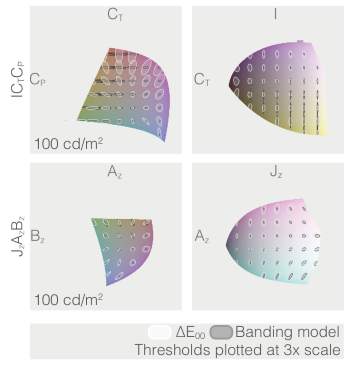
In perceptually uniform colour spaces, the perceptual differences in colour pairs are approximately the same as the Euclidean distance between them. Uniformity is of great importance in applications such as gamut mapping where the perceptual difference between original and mapped colour needs to be minimised. Ideally, in a perceptually uniform colour space, the locus of constant Just Noticeable Difference (JND) around different colour samples should be the unit sphere. While several perceptually uniform colour spaces for Standard Dynamic Range (SDR) and High Dynamic Range (HDR) have been proposed, there is not a standardized uniformity metric with respect to which we might judge whether one space is more uniform than another. In this paper, we propose and develop such a uniformity metric. Importantly, our approach takes into account changes in all three directions of a colour space including luminance and this is in contradistinction to prior art that focuses mainly on the colour signal (separate from luminance). The proposed metric can be based on any perceptual colour difference metric that models JNDs.

Quantization of images containing low texture regions, such as sky, water or skin, can produce banding artifacts. As the bitdepth of each color channel is decreased, smooth image gradients are transformed into perceivable, wide, discrete bands. Commonly used quality metrics cannot reliably measure the visibility of such artifacts. In this paper we introduce a visual model for predicting the visibility of both luminance and chrominance banding artifacts in image gradients spanning between two arbitrary points in a color space. The model analyzes the error introduced by quantization in the Fourier space, and employs a purpose-built spatio-chromatic contrast sensitivity function to predict its visibility. The output of the model is a detection probability, which can be then used to compute the minimum bit-depth for which banding artifacts are just-noticeable. We demonstrate that the model can accurately predict the results of our psychophysical experiments.