
With the rapid advancement of mobile imaging and the increasing demand for perceptually accurate white balance (WB) algorithms, the need for a comprehensive dataset providing perceptual acceptability assessments across diverse illumination conditions has arisen. To address this gap, we constructed the Multiple Illumination Scenarios (MIS) dataset, which spans both pure colors and complex objects under single and multiple illuminant conditions. Observer-based acceptability ratings were collected and analyzed across 3,465 trials, revealing heightened sensitivity to chromatic deviations in regions of low lightness and chroma. Additionally, spatial and illuminance factors were found to modulate color acceptability judgments in multi-illuminant scenarios. Based on these findings, we proposed two new metrics to improve the performance of current color difference models: one weighted by color appearance attributes and another that incorporates spatial and illuminance factors. Evaluation results demonstrated that our proposed metrics showed improved correlation with perceptual judgments across all tested color difference models. By incorporating more realistic datasets and integrating alternative WB error evaluation metrics, we aim to advance research into the prediction of WB error acceptability under complex lighting environments.
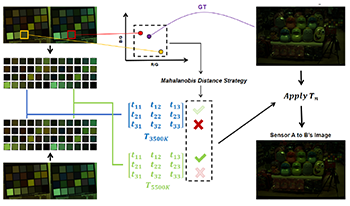
Automatic white balance (AWB) plays a crucial role in digital imaging, with modern learning-based methods achieving better performance. These methods, however, require extensive training data captured by a specific sensor, which cannot be directly deployed other sensors due to the different spectral sensitivity functions. This paper presents a novel cross-sensor adaptation method based on 3×3 color transformation matrices. By leveraging least-squares optimization and a Mahalanobis distance strategy, our approach constructs sensor-specific mapping matrices using 24-patch ColorChecker data. The results derived using the NUS dataset demonstrate that the proposed method has much smaller angular errors without requiring additional data collection or complicated network tuning.