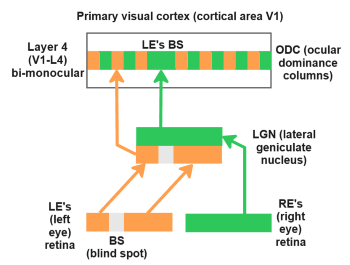
It is well established that a small percent of the color deficiency population is monocular (Judd, 1948; Broackes, 2010). On the other hand, it is also well known that under certain conditions, binocular fusion of colors (including brightness) does occur. Considering the two sides together, human color sensation is bi-monocular. Furthermore, relating the La Hire phenomenon about the physiological blind spot to the neuroanatomical finding that the blind spot is represented in V1-L4, we can infer that V1-L4 is the neural substrate for color sensations in the human brain. This neural substrate is bi-monocular in that the excitatory neurons there are monocular in terms of thalamic inputs but the two eyes monocular neurons inhabit there side by side: Together they can represent binocular information. In short, bi-monocularity is a prominent attribute of color vision worthy of further investigation. This quality of color sensation has an obvious and important implication for devices that contain eye-based displays: For example, presently, all the commercially available VR headsets (e.g., Apple s Vision Pro and Meta s Quest products) do not have separate color filter settings for the two eyes of an individual user: This feature is worthy of enhancement for the uniocular color deficient population.