
Mixed reality (MR) integrates virtual content with the physical world, enabling users to place virtual objects in real environments and interact with or observe them. As MR technologies advance, such experiences are becoming increasingly common. However, it remains unclear how the visual and interactive representation of virtual objects influences users, and few studies have examined users’ behavioral responses to virtual objects. We investigated whether representation factors (interactivity, transparency, and size) affect users’ sense of presence and their behaviors toward the object (e.g., avoidance or displacement). Here, interactivity refers to whether users can touch the virtual object. In two experiments (desk-scale and room-scale) conducted, participants performed a reaching task toward a real target located behind a virtual object whose representation factors were manipulated. Presence and behavior were assessed using subjective ratings and objective measures from tracking data and video observations. Perceived presence varied with interactivity, transparency, and size, whereas avoidance and displacement behaviors showed no reliable differences across conditions. Nonetheless, the results suggest that behavioral responses may emerge when interaction demands are stronger or the scale of interaction is larger. Overall, representation affected perceived presence but did not reliably change avoidance or displacement behavior in this task.
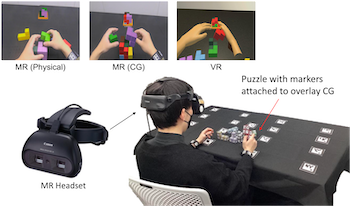
This study evaluates user experiences in Virtual Reality (VR) and Mixed Reality (MR) systems during task-based interactions. Three experimental conditions were examined: MR (Physical), MR (CG), and VR. Subjective and objective indices were used to assess user performance and experience. The results demonstrated significant differences among conditions, with MR (Physical) consistently outperforming MR (CG) and VR in various aspects. Eye-tracking data revealed that users spent less time observing physical objects in the MR (Physical) condition, primarily relying on virtual objects for task guidance. Conversely, in conditions with a higher proportion of CG content, users spent more time observing objects but reported increased discomfort due to delays. These findings suggest that the ratio of virtual to physical objects significantly impacts user experience and performance. This research provides valuable insights into improving user experiences in VR and MR systems, with potential applications across various domains.