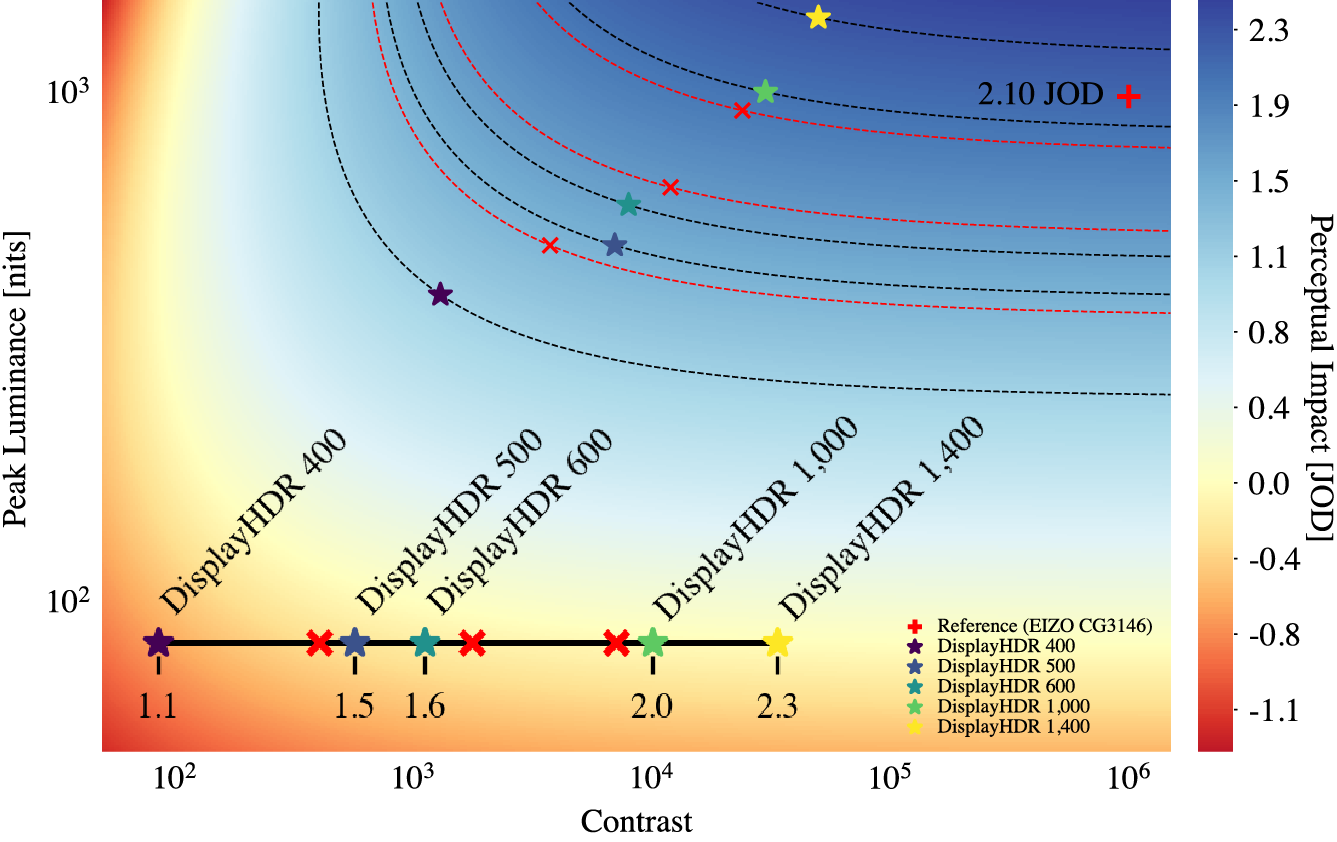
Characterization of a high dynamic range (HDR) display’s performance can be largely defined by its contrast and peak luminance. Prior work has studied this question for virtual reality (VR) using a haploscopic HDR setup, but it is not obvious if those results are transferrable to a more traditional viewing setting, such as direct view. In this work, we conducted a study to measure user preference for different contrast and peak luminance parameters in this scenario, and develop a perceptual just-objectionable-difference (JOD) scale to quantify preference scores. This is accomplished by studying contrast and peak luminance conditions across several orders of magnitude, shown on a professional HDR display with peak luminance of 1,000 nits and 1,000,000:1 contrast. The data is used to develop a computational model that can drive display design and future standardization of the definition of HDR, in terms of human preference.
The existing tone mapping operators (TMOs), compress either the high dynamic range (HDR) image luminance or RGB channels and assume uniform adaptation conditions, contrary to human vision that adapts colorfulness under varying adaptation luminance conditions. One of the challenges in tone mapping is maintaining perceptual consistency of both lightness and colorfulness under varying adaptation luminance. Unlike traditional approaches, this work proposes CIECAM16 lightness based, spatially adaptive tone mapping and allows colorfulness according to local adaptation luminance. Furthermore, it uses spatial white point instead of a global one aligning the human perceptual phenomenon. The paper further analyzes the performance of the proposed TMO across various spatial conditions, demonstrating that it preserves local contrast and maintains detail in both highlight and shadow regions while adaptively regulating colorfulness under various adaptation conditions. Hence, this adaptive approach for HDR to standard dynamic range (SDR) mapping offers perceptually faithful representation.
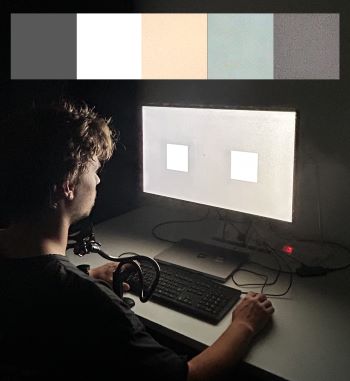
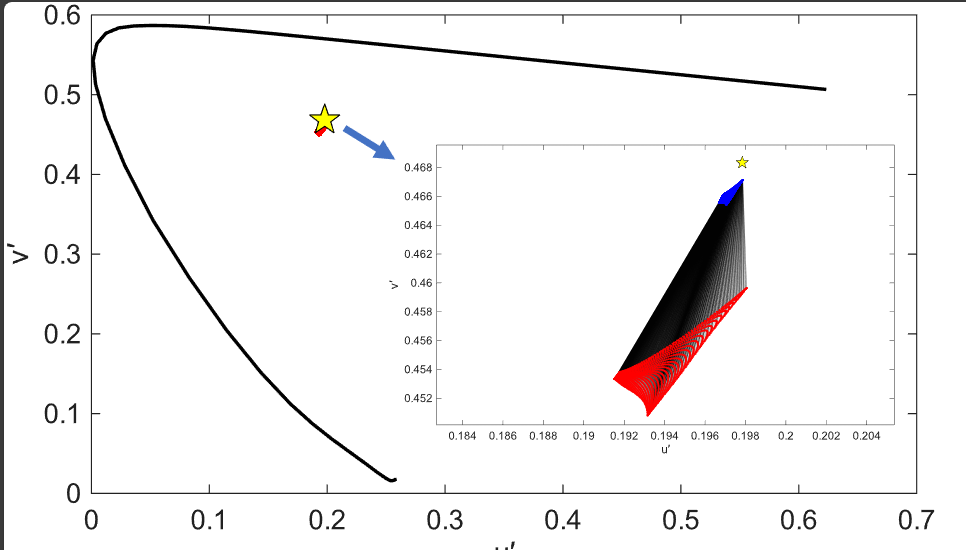
Currently available visual noise estimation algorithms are primarily developed and calibrated using SDR images, which limits their accuracy in representing the actual noise perceived by humans in HDR content. One key factor often overlooked is the luminance adaptation of the observer, especially when there is a significant contrast between the observed patch and its surrounding area. Moreover, the design of existing test charts, combined with increasingly sophisticated local tone mapping algorithms, introduces new challenges. A prominent issue is the presence of gradients in the final image, which significantly affect algorithmic measurements but have minimal impact on human perception: for instance, a patch may register a Just Noticeable Difference (JND) of 6 compared to a perfectly clean patch with zero noise, despite being visually clean and not visibly different. This paper proposes a new direction for visual noise algorithms and sets the foundations for future research. It presents findings on: 1) A new HDR ruler for visual noise assessment. 2) The impact of various factors (CSF, HPF, gradient correction) on algorithm performance. 3) Evaluation of different color spaces to calculate visual noise metrics.
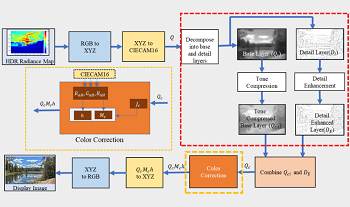
A significant challenge in tone mapping is to preserve the perceptual quality of high dynamic range (HDR) images when mapping them to standard dynamic range (SDR) displays. Most of the tone mapping operators (TMOs) compress the dynamic range without considering the surround viewing conditions such as average, dim and dark, leading to the unsatisfactory perceptual quality of the tone mapped images. To address this issue, this work focuses on utilizing CIECAM16 brightness, colorfulness, and hue perceptual correlates. The proposed model compresses the perceptual brightness and transforms the colors from HDR images using CIECAM16 color adaptations under display conditions. The brightness compression parameter was modeled via a psychophysical experiment. The proposed model was evaluated using two psychophysical experimental datasets (Rochester Institute of Technology (RIT) and Zhejiang University (ZJU) datasets).