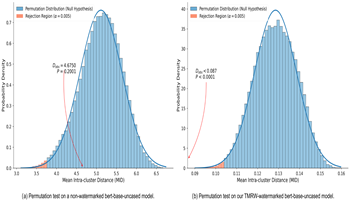
Protecting the intellectual property of natural language encoders faces a critical challenge: hidden watermarks are easy to be erased when models are fine-tuned to adapt to downstream applications, known as “task migration”. To deal with this problem, we introduce a Task Migration Resistant Watermarking (TMRW) framework to strengthen the watermark robustness against task migration. The proposed method uses a dual-objective fine-tuning strategy. During the process of watermark embedding, a specifically designed watermark loss function is introduced to compel the encoder to map a set of trigger inputs into a compact cluster in the embedding space. To counteract the potential performance degradation introduced by this process, an augmented contrastive loss is simultaneously optimized to preserve the encoder’s general semantic representation abilities. This dual-objective strategy is further enhanced by a novel trigger corpus crafting method that ensures the watermark’s stealthiness. Experimental results show that the proposed method enables the embedding of a robust watermark that significantly outperforms existing techniques in resisting erasure from task migration. This work well deals with the challenge of encoder watermark’s durability against task migration, which provides a novel and practical framework for intellectual property protection in natural language processing systems.