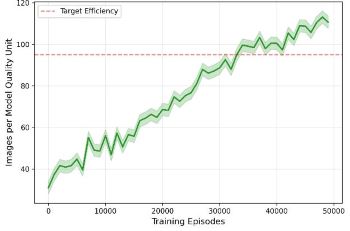
The computational footprint of 3D photogrammetry is a growing concern. This is due to the standard workflows that often need hundreds or thousands of high-resolution images to achieve high-fidelity results. This places a significant energy burden on processing hardware, thereby increasing costs and environmental impact. In this proposal, EcoScan is presented as a novel, sustainable photogrammetry workflow that minimizes computational resource consumption. EcoScan utilizes an on-device Reinforcement Learning (RL) agent that functions as an intelligent photographer. Its purpose is to make real-time decisions regarding which frames to capture and suggest optimal camera movements to maximize information gain per pixel. This yields a minimal yet sufficient image dataset that should be efficient for downstream processing. The proposed approach reformulates the capture process as a Markov Decision Process (MDP) with a reward function that balances reconstruction quality with computational energy costs. Results show that EcoScan reduces the number of required input images by 3-5 times compared to conventional methods while achieving equivalent reconstruction accuracy. This translates to a 60-70% reduction in total energy consumption during the SfM and MVS processing phases. The EcoScan framework provides a pathway towards sustainable 3D digitization without compromising quality.