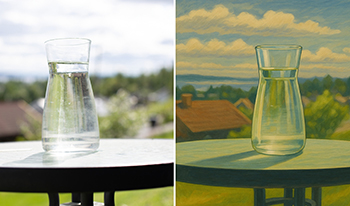
Distortions introduced during the reproduction of digital images can lead to substantial changes in their color composition. The motivations for altering images range from practical purposes, such as image compression and color quantization to reduce file size, to more aesthetic applications like style transfer using generative AI. In this work, we investigate how the reproduction of color images affects material appearance, in particular, the perception of gloss and translucency. We applied different image quality distortions to natural images of glossy and translucent objects. Additionally, we Ghiblified them – a recent viral social media phenomenon of mimicking the Japanese anime style using generative AI style transfer. Afterward, we conducted a series of user studies to evaluate the fidelity of gloss and translucency reproduction. The experimental results represent how the reproductions are perceived by image quality metrics and open up a new direction for material appearance studies.

Transfer Learning is an important strategy in Computer Vision to tackle problems in the face of limited training data. However, this strategy still heavily depends on the amount of availabl data, which is a challenge for small heritage institutions. This paper investigates various ways of enrichingsmaller digital heritage collections to boost the performance of deep learningmodels, using the identification of musical instruments as a case study. We apply traditional data augmentation techniques as well as the use of an external, photorealistic collection, distorted by Style Transfer. Style Transfer techniques are capable of artistically stylizing images, reusing the style from any other given image. Hence, collections can be easily augmented with artificially generated images. We introduce the distinction between inner and outer style transfer and show that artificially augmented images in both scenarios consistently improve classification results, on top of traditional data augmentation techniques. However, and counter-intuitively, such artificially generated artistic depictions of works are surprisingly hard to classify. In addition, we discuss an example of negative transfer within the non-photorealistic domain.